
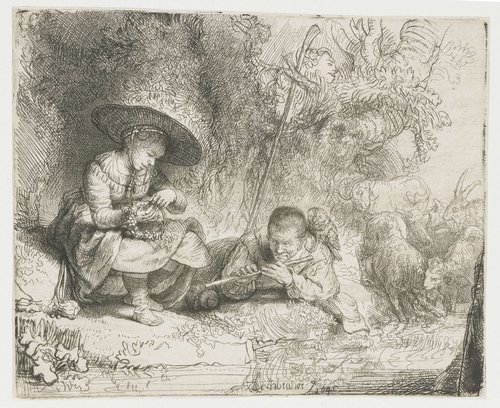
The flute player
Medium
etching
Dimensions
143; 117
Rights
Public Domain
About this artwork
ets en droge naald
Art Historical Context
In the heart of the Dutch Golden Age, Rembrandt vanijn created *The Flute Player* in1642, a masterful etching that captures the intimate glow of everyday life. Measuring just 117mm by 143mm, this-scale print exemplifies Rembrandt's genius for transforming modest scenes into profound studies of light, texture, and human presence. The artist, at the height of his career in Amsterdam, often turned to musicians and ordinary figures as subjects, infusing them with emotional depth and a sense of drama characteristic of Baroque artistry. What sets this work apart is Rembrandt's innovative use of etching combined with drypoint—a technique noted in its description as "ets en droge naald." Etching allowed for precise, fluid lines, while drypoint's burr created velvety, tonal richness, mimicking the chiaroscuro effects of his oil paintings. This hybrid method produced subtle gradations of shadow and a tactile quality that made his prints highly sought after, rivaling paintings in expressiveness. *The Flute Player* reflects Rembrandt's exploration of light piercing darkness, drawing viewers into the musician's contemplative world. As one of hundreds of etchings he produced, it highlights his technical virtuosity and enduring appeal, offering museum-goers a window into 17th-century Holland's cultural vibrancy.
About the Artist
Rembrandt van Rijn · 1606–1669
Rembrandt Harmenszoon van Rijn (1606–1669) stands as one of the greatest visual artists in the history of Western art and the most important Dutch painter of the 17th century. Born in Leiden to a prosperous miller's family, Rembrandt transformed painting through his revolutionary use of light and shadow, his psychological depth in portraiture, and his elevation of etching to a fine art. His approx...