
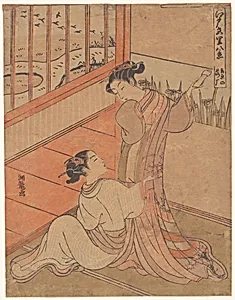
The Flying Down of Wild Geese at Yoshiwara
Medium
Woodblock print; ink and color on paper
Dimensions
H. 9 1/2 in. (24.1 cm); W. 7 7/16 in. (18.9 cm)
Classification
Prints
Culture & Period
Japan · Edo period (1615–1868)
Department
Asian Art
Museum
Metropolitan Museum of Art, New York, NY
Credit
H. O. Havemeyer Collection, Bequest of Mrs. H. O. Havemeyer, 1929
Accession Number
JP1697
Rights
Public Domain
Tags
Art Historical Context
In the vibrant world of Edo-period Japan (1615–1868), Isoda Koryūsai's *The Flying Down of Wild Ge at Yoshiwara* captures a poetic moment through the delicate art of ukiyo-e woodblock printing. This intimate print, measuring just 9½ by 7⅜ inches, uses ink and on paper to evoke the "floating world" of fleeting pleasures. Koryūsai, a master of the genre known for his elegant depictions of beautiful women (bijin-ga), blends nature and human elegance here, showing graceful figures amid descending wild geese at Yoshiwara—the famed pleasure district of Edo (modern Tokyo). Woodblock prints like this were produced via a collaborative process: artists designed, carvers shaped blocks for each color, and printers applied pigments layer by layer, allowing vivid hues and fine details on mulberry paper. The scene likely symbolizes seasonal migration and transience, themes central to Japanese aesthetics, with Yoshiwara's courtesans as symbols of ephemeral beauty. Housed in the Metropolitan Museum of Art's Asian Art Department from the H.O. Havemeyer Collection (1929), this work exemplifies ukiyo-e's cultural role in democratizing art for everyday viewers, offering a glimpse into 18th-century urban life and artistry.
About the Artist
Isoda Koryūsai · 1735–1790
Japanese, 1735–ca. 1790