
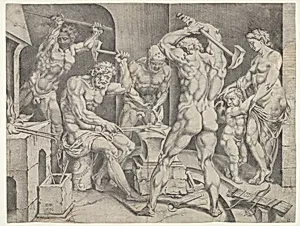
The Forge of Vulcan
1546
Medium
Engraving
Dimensions
sheet: 11 3/16 x 14 13/16 in. (28.4 x 37.7 cm)
Classification
Prints
Department
Drawings and Prints
Museum
Metropolitan Museum of Art, New York, NY
Credit
Bequest of Phyllis Massar, 2011
Accession Number
2012.136.904
Rights
Public Domain
Tags
Art Historical Context
In the bustling workshop of the gods, Cornelis Bos's *The Forge of Vulcan* (1546) captures a dynamic mythological scene from classical antiquity. The Dutch engraver depicts Vulcan, the Roman god of fire and metalworking, amid his muscular assistants—likely cyclopes—hammering away at an anvil. Surrounded by female nudes possibly Venus or her attendants, the composition pulses with energy, blending male and female forms in a celebration of the human body. This engraving, measuring 11 3/16 x 14 13/16 inches, now resides in the Metropolitan Museum of Art's Drawings and Prints department, thanks to the 2011 bequest of Phyllis Massar. Created during the Northern Renaissance, Bos's work reflects the era's fascination with Italian Renaissance masters like Michelangelo, whose influence on anatomical precision and dramatic poses is evident here. As a reproductive printmaker, Bos excelled in translating paintings into intricate engravings, making elite art accessible to a wider audience across Europe. The medium's fine lines allowed for rich detailing in the nudes' rippling muscles and the glowing forge, showcasing Mannerist tendencies toward elongated figures and complex narratives. This piece not only highlights Vulcan's craftsmanship but also Renaissance humanism's reverence for the nude as an ideal of beauty and strength. A testament to 16th-century print innovation, it invites visitors to ponder how myths fueled artistic innovation.
About the Artist
Cornelis Bos · 1510–1556
Cornelis Bos (c. 1506/10–before 1555), a Netherlandish engraver, printseller, and publisher born in 's-Hertogenbosch, emerged as a pivotal figure in the Antwerp print trade during the mid-16th century. His early life remains sparsely documented, with no records of formal training or mentors, though he was active in Antwerp by 1537, producing his earliest known engraving, *Prudence and Justice*, af...