
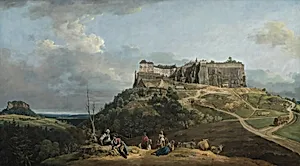
The Fortress of Königstein
1756-1758
Medium
oil on canvas
Dimensions
overall: 133 x 235.7 cm (52 3/8 x 92 13/16 in.) framed: 159.4 x 263.5 x 6.4 cm (62 3/4 x 103 3/4 x 2 1/2 in.)
Classification
Painting
Department
CIS-B
Museum
National Gallery of Art, Washington, D.C.
Credit
Patrons' Permanent Fund
Accession Number
1993.8.1
Rights
Public Domain
Art Historical Context
Bernardo Bellotto’s *The Fortress of Königstein* (1756–1758) presents a sweeping view of the celebrated Saxon stronghold perched dramatically above the Elbe River valley. A nephew and pupil of Canaletto, Bellotto became one of the foremost vedutisti of the eighteenth century, specializing in meticulously observed cityscapes and landscapes for European courts. Working in oil on a grand canvas more than two meters wide, he combined precise architectural detail with luminous atmospheric effects, inviting viewers to experience both the fortress’s imposing scale and the tranquil countryside surrounding it. Painted during Bellotto’s residence in Dresden for the Saxon ruler Augustus III, the work belongs to a celebrated series documenting the king’s principal residences and fortifications. The Fortress of Königstein, long a symbol of regional power and strategic defense, appears here not merely as a military site but as a harmonious element within the landscape—an Enlightenment-era meditation on human achievement set against nature’s grandeur. Today in the collection of the National Gallery of Art, the painting continues to reward close looking: its expansive format and subtle handling of light allow visitors to appreciate Bellotto’s rare ability to merge topographical accuracy with poetic vision.
About the Artist
Bernardo Bellotto · 1722–1780
Bernardo Bellotto (1722–1780) was an Italian painter of exceptional gifts who carried the art of the veduta — the precisely observed topographical view — from Venice across the courts of northern Europe, leaving behind some of the most detailed and haunting urban panoramas in the history of Western painting. Born in Venice, he was the nephew and pupil of the great vedutista Giovanni Antonio Canal,...