
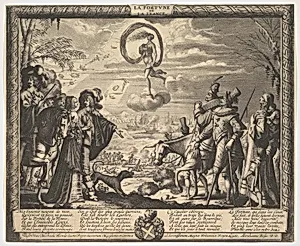
The Fortune of France
Medium
Etching; second state of two
Dimensions
Sheet (trimmed): 10 3/16 × 12 3/8 in. (25.8 × 31.5 cm)
Classification
Prints
Department
Drawings and Prints
Museum
Metropolitan Museum of Art, New York, NY
Credit
Bequest of Phyllis Massar, 2011
Accession Number
2012.136.19
Rights
Public Domain
Tags
Art Historical Context
In the bustling world of 17th-century French print, *The Fortune of France*ca. 1638) stands as a collaborative etching by Abraham Bosse, a master of detailed reproductive prints, and Roland Leond le Jeune. second state of two—a refined version with possible added details or corrections—captures an allegorical scene evoking France's prosperity during the reign of Louis XIII. Etching, Bosse's favored technique involved drawing acid-resistant lines on a copper plate, immersing it in acid to etch grooves, then inking and printing. This allowed for intricate textures and narratives, making fine art accessible beyond paintings. Rendered on a trimmed sheet measuring 10 3/16 × 12 3/8 inches, the print likely teems with men, women, dogs, and horses, symbolizing abundance and national vigor amid Cardinal Richelieu's era of cultural and political ambition. Bosse, influenced by the French Baroque, excelled at social vignettes that blended realism with moral or patriotic themes, reflecting the era's fascination with emblematic imagery. Housed in the Metropolitan Museum of Art's Drawings and Prints department through the Bequest of Phyllis Massar (2011), it offers visitors a window into how prints democratized art, preserving fleeting moments of grandeur for posterity.
About the Artist
Abraham Bosse|Roland Leblond le Jeune · 1602–1676
Abraham Bosse (1604–1676) was a French printmaker and theorist whose approximately 1,600 etchings provide an unparalleled visual record of 17th-century French life. Born to Huguenot parents in Tours, he trained in Paris under Melchior Tavernier and became a devoted follower of Jacques Callot's technical innovations. Bosse's meticulous etchings depicted subjects ranging from daily life and fashion ...