
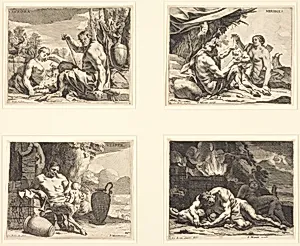
The Four Times of Day
c. 1640
Medium
complete set of four etchings with engraving on laid paper
Classification
Department
CG-E
Museum
National Gallery of Art, Washington, D.C.
Credit
Ailsa Mellon Bruce Fund
Accession Number
2007.18.1-4
Rights
Public Domain
Art Historical Context
**The Four Times of Day** a captivating complete set of four etchings with engraving on laid paper, created around 1640 by Charles Le Brun a leading figure in French Baroque art. just 21 years old Le Brun produced this early masterpiece, showcasing his precocious talent before rising to prominence as First Painter to Louis XIV and founder of the Royal Academy of Painting and Sculpture. The series allegorically captures the daily cycle—dawn, noon, evening, and night—through dynamic compositions that blend classical influences with emerging French grandeur. Printed on laid paper, a fine 17th-century support with its characteristic chain lines, these works highlight Le Brun's mastery of mixed techniques: etching for fluid lines and engraving for precise detailing. Prints like these democratized high art, allowing wider audiences beyond elite patrons to experience Baroque drama and humanism. Thematically rooted in timeless motifs from antiquity, they reflect the era's fascination with time, nature, and harmony. Today, this elegant set graces the National Gallery of Art's Department of Prints (CG-E), acquired through the Ailsa Mellon Bruce Fund. It offers visitors a window into Le Brun's formative years and the innovative printmaking that bridged painting and popular culture in the Baroque age.
About the Artist
Charles Le Brun · 1619–1690
Charles Le Brun (1619–1690) was the most powerful artistic figure in seventeenth-century France, serving as the virtual dictator of official taste during the reign of Louis XIV and shaping the visual identity of the French Baroque in ways that resonated for generations. Born in Paris, he trained under the painter Simon Vouet before traveling to Rome in 1642, where he studied the works of Nicolas P...