
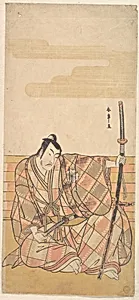
The Fourth Matsumoto Koshiro as a Samurai
ca. 1782
Medium
Woodblock print (nishiki-e); ink and color on paper
Dimensions
12 4/5 x 5 3/4 in. (32.5 x 14.6 cm)
Classification
Prints
Culture & Period
Japan · Edo period (1615–1868)
Department
Asian Art
Museum
Metropolitan Museum of Art, New York, NY
Credit
Rogers Fund, 1914
Accession Number
JP119
Rights
Public Domain
Tags
Art Historical Context
Behold *The Fourth Matsumoto Kōshirō as a Samurai a vibrant woodblock print (nishiki-e by Katsukawa Shunsh, one of the leading masters of ukiyo-e during Japan's Edo period (16151868). Created around 1782, this portrait captures the renowned kabuki actor in a dynamic samurai pose, sword at the ready, his fierce expression and flowing robes embodying the dramatic intensity of the stage. Measuring just 12⅘ x 5¾ inches, it exemplifies the accessible scale of these prints, designed for urban collectors in bustling Edo (modern Tokyo). Shunshō, founder of the influential Katsukawa school, specialized in yakusha-e—actor portraits that blurred the lines between theater and everyday heroism. Nishiki-e, or "brocade pictures," revolutionized printmaking with their lavish multicolored inks layered through intricate woodblocks, bringing unprecedented realism and vibrancy to paper. This technique highlighted the star power of actors like Matsumoto Kōshirō IV, whose larger-than-life personas fueled kabuki's golden age, reflecting Edo society's fascination with the "floating world" of entertainment and transient pleasures. As a cultural snapshot, the print underscores kabuki's role in democratizing art, where commoners could own celebrity likenesses. Today, housed in the Metropolitan Museum of Art's Asian Art Department (Rogers Fund, 1914), it invites us to appreciate how Shunshō's bold lines and rich hues immortalized Japan's theatrical soul.
About the Artist
Katsukawa Shunshō 勝川春章 (Japanese) · 1726 –1792
Japanese, 1726–1792