
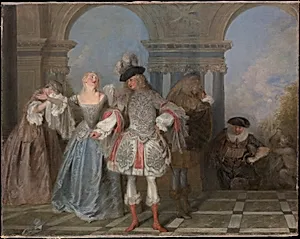
The French Comedians
ca. 1720
Medium
Oil on canvas
Dimensions
22 1/2 x 28 3/4 in. (57.2 x 73 cm)
Classification
Paintings
Department
European Paintings
Museum
Metropolitan Museum of Art, New York, NY
Credit
The Jules Bache Collection, 1949
Accession Number
49.7.54
Rights
Public Domain
Tags
Art Historical Context
Antoine Watteau, a pioneering master of the Rococo style, created *The French Comedians* around 1720, capturing the enchanting world of itinerant actors from the Commedia dell'arte tradition. This oil on canvas painting, measuring 22½ × 28¾ inches, depicts a lively group of male and female performers in theatrical costumes, poised in a moment of poised elegance that blurs the line between stage and everyday life. Belonging to the European Paintings department at the Metropolitan Museum of Art (The Jules Bache Collection, 1949), it exemplifies Watteau's *fêtes galantes*—idyllic scenes of leisure and fantasy that defined early 18th-century French art. Watteau's virtuoso technique shines through his fluid brushwork, soft lighting, and vibrant yet delicate colors, evoking a dreamlike atmosphere. The actors, likely from the popular Italian comedy troupes in Paris, represent archetypal roles like Harlequin and Pierrot, reflecting the cultural fascination with theater during the Regency era under the Duc d'Orléans. This work's intimacy and psychological depth make it a standout in Watteau's oeuvre, one of his final masterpieces before his early death in 1721. For visitors, *The French Comedians* offers a window into the exuberant spirit of Rococo France, where art celebrated wit, performance, and human connection amid societal change.
About the Artist
Antoine Watteau · 1684–1721
Jean-Antoine Watteau, born in 1684 in Valenciennes to a modest family—his father a roofer named Jean-Philippe Watteau—was the second of four sons who displayed an early passion for art. After initial apprenticeship under local painter Jacques-Albert Gérin, he moved to Paris around 1702, working in workshops copying Flemish and Dutch genre scenes. By 1705, he entered the studio of Claude Gillot, ab...