
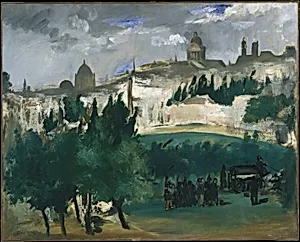
The Funeral
ca. 1867
Medium
Oil on canvas
Dimensions
28 5/8 x 35 5/8 in. (72.7 x 90.5 cm)
Classification
Paintings
Department
European Paintings
Museum
Metropolitan Museum of Art, New York, NY
Credit
Catharine Lorillard Wolfe Collection, Wolfe Fund, 1909
Accession Number
10.36
Rights
Public Domain
Tags
Art Historical Context
Édouard Manet’s *The Funeral* (ca 1867) captures a poignant moment of Parisian life during the Second Empire, depicting a somber funeral procession winding through the rain-slicked streets. Rendered in oil on canvas, this 28⅝ × 35⅝-inch work blends landscape and urban scene, showcasing the artist’s signature loose brushwork and flattened composition. Manet, a pivotal figure bridging Realism and Impressionism, elevates an everyday bourgeois ritual—marked by black-clad mourners and a horse-drawn hearse—into a modern tableau, drawing from Spanish masters like Velázquez while observing contemporary France. Painted amid Paris’s rapid Haussmannization, the scene reflects the city’s transformation and the anonymity of urban existence. The misty atmosphere and muted palette evoke transience, with the vast sky dominating the canvas to underscore human fragility. Though not a formal Impressionist yet, Manet’s innovative approach challenged academic conventions, paving the way for later movements by prioritizing direct observation over idealization. Housed in the Metropolitan Museum of Art’s European Paintings department (Catharine Lorillard Wolfe Collection, 1909), *The Funeral* invites visitors to ponder mortality amid the bustle of 19th-century Paris—a timeless reminder of life’s quiet dramas.
About the Artist
Edouard Manet · 1832–1883
Édouard Manet (1832-1883) was a French painter who played a pivotal role in the transition from Realism to Impressionism, often called the 'Father of Modern Art.' Born into a wealthy Parisian family, Manet defied his father's wishes for a legal career to pursue painting, studying under academic artist Thomas Couture. His revolutionary works 'Le Déjeuner sur l'herbe' and 'Olympia' (both 1863) scand...