
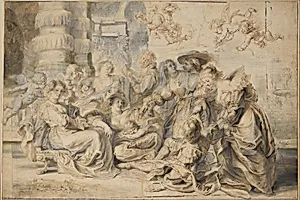
The Garden of Love (right portion)
ca. 1633–35
Medium
Pen and brown ink, brown and green wash, heightened with light blue gouache, over black chalk
Dimensions
18 3/4 x 27 13/16 in. (47.6 x 70.6 cm)
Classification
Drawings
Department
Drawings and Prints
Museum
Metropolitan Museum of Art, New York, NY
Credit
Fletcher Fund, 1958
Accession Number
58.96.2
Rights
Public Domain
Tags
Art Historical Context
Peter Paul Rubens, the leading Flemish master of the Baroque, produced this vibrant drawing around 1633–35. Known as the right portion of *The Garden of Love*, it presents an allegorical gathering of men, women, and playful putti in a lush outdoor setting, celebrating themes of courtship and earthly delight that defined much of Rubens’s mature work. His Baroque style—full of movement, sensuality, and emotional warmth—shines through even in this preparatory sheet. Rubens combined pen and brown ink with brown and green washes, then added touches of light blue gouache over a black-chalk underdrawing. This mixed-media approach let him rapidly block in figures, suggest atmosphere, and indicate color, making such drawings essential tools in his busy workshop for developing large-scale paintings. Now housed at the Metropolitan Museum of Art, the sheet offers a direct window into Rubens’s creative process in his later years. It captures the Baroque fascination with love, nature, and human connection, inviting viewers to feel the artist’s energetic hand at work.
About the Artist
Peter Paul Rubens|Peter Paul Rubens · 1577–1640
Peter Paul Rubens (1577-1640) stands as the most influential artist of the Flemish Baroque tradition and the greatest exponent of Baroque painting's dynamism, vitality, and sensuous exuberance. Born in Siegen, Westphalia, and raised in Antwerp, Rubens received a humanist education studying Latin and classical literature before pursuing artistic training under three masters: Tobias Verhaecht, Adam ...