
The Golden Age
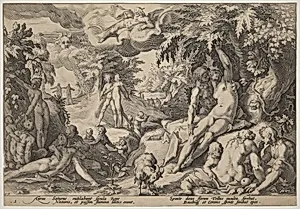
Medium
engraving on laid paper
Dimensions
sheet: 18.5 x 26.2 cm (7 5/16 x 10 5/16 in.), cut within platemark
Classification
Department
CG-E
Museum
National Gallery of Art, Washington, D.C.
Credit
Gift of the Estate of Leo Steinberg
Accession Number
2011.139.164
Rights
Public Domain
Art Historical Context
**The Golden Age**, an engraving on laid paper from around 1589, hails from the workshop of Hendrick Goltzi, the renowned Dutch Mannerist engraver, faithfully reproducing his original design. Measuring just 18.5 x 26.2 cm, this intimate print captures Goltzius's mastery of the burin, creating rich, swelling lines that mimic the fluidity of brushstrokes. Produced during the late Renaissance in Haarlem—a thriving hub of Northern European printmaking—this work exemplifies the era's innovative reproductive techniques, allowing designs to be widely disseminated to collectors and scholars across Europe. Goltzius, often called the "Dutch Michelangelo," revolutionized engraving with his dramatic chiaroscuro effects and anatomical precision, bridging painting and print. Here, his workshop's skilled artisans perpetuated his vision, a common practice that amplified an artist's influence. The title evokes the classical myth of the Golden Age—a utopian era of harmony and abundance from Ovid's *Metamorphoses*—reflecting Renaissance nostalgia for antiquity amid the Dutch Revolt's turmoil. As a gift to the National Gallery of Art from the Estate of Leo Steinberg, this print highlights engraving's cultural role: affordable art that educated and inspired. Its laid paper, with visible chain lines, underscores authentic 16th-century craftsmanship, inviting visitors to appreciate how such small-scale wonders shaped artistic exchange.