
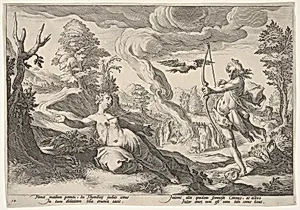
Apollo and Coronis
Medium
Engraving
Dimensions
sheet: 7 1/16 x 10 1/16 in. (18 x 25.5 cm)
Classification
Prints
Department
Drawings and Prints
Museum
Metropolitan Museum of Art, New York, NY
Credit
Bequest of Phyllis Massar, 2011
Accession Number
2012.136.477
Rights
Public Domain
Tags
Art Historical Context
Behold *Apollo and Coronis*, captivating engraving from the late 16th or early 17th century, created by Dutch engraver Robert Willemsz de Baudous after a design by the renowned Hendrick Goltzius. Goltzius, a of Mannerism, was celebrated for his dynamic compositions and intricate line work, which revolutionized printmaking in Northern Europe. This sheet, measuring just 7 1/16 x 10 1/16 inches, exemplifies the era's technical prowess in engraving—a labor-intensive intaglio process where metal plates were incised with burins to produce rich, detailed impressions that could be widely distributed. The scene draws from Ovid's *Metamorphoses*, depicting the god Apollo with his bow and arrow, accompanied by birds, likely alluding to the tragic tale of his lover Coronis. Betrayed by infidelity, she meets a fatal end by Apollo's hand, with a raven as the fateful messenger. Such mythological subjects were immensely popular during the Renaissance, blending classical antiquity with humanist ideals and serving as moral allegories for collectors and scholars. Housed in the Metropolitan Museum of Art's Drawings and Prints department through the bequest of Phyllis Massar in 2011, this print highlights engraving's role in democratizing high art. Goltzius's influence shines through in the fluid, muscular forms and dramatic tension, inviting viewers to ponder love, jealousy, and divine retribution in a miniature masterpiece of technical and narrative brilliance.
About the Artist
Robert Willemsz de Baudous|Hendrick Goltzius (Netherlandish|Netherlandish) · 1574 |1558 –1659 |1617
Netherlandish, 1574/5–1659|Netherlandish, Mühlbracht 1558–1617 Haarlem