
The Good Samaritan
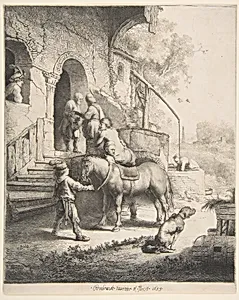
Medium
Etching, engraving and drypoint; fourth state of four
Dimensions
Sheet: 9 15/16 × 8 1/16 in. (25.3 × 20.4 cm)
Classification
Prints
Department
Drawings and Prints
Museum
Metropolitan Museum of Art, New York, NY
Credit
Gift of Henry Walters, 1917
Accession Number
17.37.192
Rights
Public Domain
Tags
Art Historical Context
Rembrandt van Rijn'sThe Good Samaritan* (1633) is a masterful etching capturing the biblical parable from Luke 10, where a compassionate Samaritan aids a robbed traveler left for dead by the roadside. Created during Rembrandt's early years in Amsterdam, when he was establishing himself as a leading artist, this print vividly dramatizes the scene at a bustling inn. Figures—men, women, a dog, and horses—fill the composition, conveying motion and humanity amid the story's moral urgency, a hallmark of Rembrandt's Baroque style emphasizing light, shadow, and emotional depth. Printed in etching, engraving, and drypoint on a modest sheet (9 15/16 × 8 1/16 in.), this fourth and final state showcases Rembrandt's innovative printmaking process. He reworked the copper plate multiple times, adding rich drypoint burrs for velvety textures and heightened contrast, making each impression uniquely luminous. This technique elevated prints from mere reproductions to standalone artworks, rivaling his paintings in expressiveness. Housed in the Metropolitan Museum of Art's Drawings and Prints department (gift of Henry Walters, 1917), *The Good Samaritan* highlights Rembrandt's genius in storytelling through graphics. Visitors will appreciate its intricate details—glinting armor, weary expressions, and atmospheric haze—inviting reflection on themes of kindness that resonate across centuries.
About the Artist
Rembrandt (Rembrandt van Rijn) · 1606–1669
Rembrandt Harmenszoon van Rijn (1606–1669) stands as one of the greatest visual artists in the history of Western art and the most important Dutch painter of the 17th century. Born in Leiden to a prosperous miller's family, Rembrandt transformed painting through his revolutionary use of light and shadow, his psychological depth in portraiture, and his elevation of etching to a fine art. His approx...