
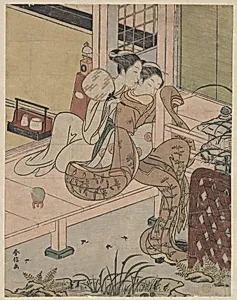
The Gossips
ca. 1767
Medium
Woodblock print; ink and color on paper
Dimensions
10 1/4 x 7 1/4 in. (26 x 18.4 cm)
Classification
Prints
Culture & Period
Japan · Edo period (1615–1868)
Department
Asian Art
Museum
Metropolitan Museum of Art, New York, NY
Credit
Gift of Estate of Samuel Isham, 1914
Accession Number
JP868
Rights
Public Domain
Tags
Art Historical Context
Suzuki Harunobu *The Gossips*ca. 1767 captures a lively moment of social life in Edo-period Japan1615–1868 a time when bustling urban culture thrived in like Tokyo (then Edo). This woodblock print depicts women engaged in animated conversation, wielding fans—a common accessory symbolizing grace, flirtation, and subtle communication in Japanese society. Harunobu, a master of ukiyo-e ("pictures of the floating world"), pioneered full-color nishiki-e prints around 1765, revolutionizing the medium with vibrant inks layered over meticulously carved wooden blocks for mass production and affordability. Measuring just 10¼ × 7¼ inches, the intimate scale suits personal viewing or even fan-shaped formats, as hinted by the tags. Harunobu's delicate lines and subtle color gradients bring a sense of intimacy and realism to his bijin-ga (images of beautiful women), blending humor with elegance. Women gossiping reflects the era's fascination with fleeting pleasures, theater, and courtesan culture. Housed in the Metropolitan Museum of Art's Asian Art collection, this print exemplifies how ukiyo-e democratized art, offering glimpses into Japan's vibrant social tapestry. Next time you spot friends chatting with fans, channel Harunobu's whimsical eye!
About the Artist
Suzuki Harunobu · 1725–1770
Suzuki Harunobu (c. 1725-1770) was a Japanese ukiyo-e artist who revolutionized woodblock printing by developing nishiki-e—full-color prints using multiple woodblocks—in 1765. Before Harunobu, Japanese prints were limited to two or three colors; his innovation unleashed the entire artist's palette, transforming ukiyo-e into the vibrant art form that would later captivate Western artists from Manet...