
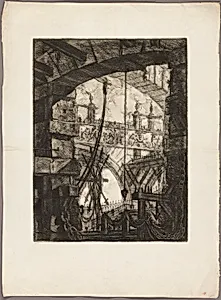
The Grand Piazza, plate 4 from Imaginary Prisons
Medium
Etching and engraving on heavy ivory laid paper
Dimensions
Image: 54 × 41 cm (21 5/16 × 16 3/16 in.); Plate: 54.8 × 41.6 cm (21 5/8 × 16 7/16 in.); Sheet: 79 × 58.4 cm (31 1/8 × 23 in.)
Classification
etching
Department
Prints and Drawings
Museum
Art Institute of Chicago
Accession Number
96166
Rights
Public Domain
Art Historical Context
Step into the shadowy grandeur of *The Grand Piazza, plate 4 frominary Prisons* (1761), a masterful etching and engraving by Giovanni Battista Piranesi, the visionary 18th-century Italian artist and architect. Part of his iconic *Carceri d'Invenzione* (Imaginaryisons) series, this plunges viewers into a colossal, labyrinthine piazza of towering arches, crumbling vaults, and endless staircases defy gravity and logic. Measuring an imposing 54 × 41 cm, it was printed on heavy ivory laid paper, a durable choice that enhanced its intricate details and dramatic scale. Piranesi's virtuoso technique—combining the fluid spontaneity of etching with the precise lines of engraving—creates an atmosphere of sublime mystery and psychological depth. His Baroque-inspired visions blend real Roman architecture with fantastical invention, evoking the Enlightenment's fascination with antiquity, ruins, and the boundless human imagination. These "prisons" weren't literal jails but metaphors for the mind's confines, influencing Romantic artists and architects alike. Housed in the Art Institute of Chicago's Prints and Drawings department, this plate exemplifies Piranesi's revolutionary printmaking, inviting us to wander its impossible spaces and ponder the interplay of order and chaos in art. A timeless invitation to dream amid the dramatic! (198 words)
About the Artist
Giovanni Battista Piranesi · 1720–1778
Giovanni Battista Piranesi (1720–1778) was an Italian printmaker, architect, and antiquarian whose visionary etchings of Rome and imaginary prisons revolutionized architectural representation and profoundly influenced both Neoclassicism and Romanticism. Piranesi stands as one of the most important printmakers of the eighteenth century, fundamentally shaping European perceptions of ancient Rome an...