
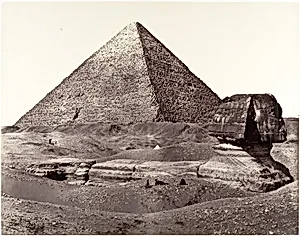
The Great Pyramid and The Great Sphinx
1858
Medium
Albumen silver print from glass negative
Dimensions
Image: 38.7 x 49.3 cm (15 1/4 x 19 7/16 in.)
Classification
Photographs
Department
Photographs
Museum
Metropolitan Museum of Art, New York, NY
Credit
Gilman Collection, Purchase, William Talbott Hillman Foundation Gift, 2005
Accession Number
2005.100.555
Rights
Public Domain
Tags
Art Historical Context
Step into the shadow of eternity with Francis Frith's *The Great Pyramid and The Sphinx* (1858), a stunning albumen silver print that captures ancient Egypt's enduring wonders.ith, a pioneering British photographer, ventured into the Nile Valley during his 1857 expedition, hauling heavy glass plate cameras across deserts to document these colossal monuments. The image frames the majestic Pyramid of Khufu and the enigmatic Great Sphinx at Giza, their weathered forms dwarfing the foreground figures, evoking the sublime scale of pharaonic engineering from over 4,500 years ago. This photograph exemplifies mid-19th-century photography's technical triumphs. The albumen silver process, using egg whites to bind light-sensitive silver salts on paper, produced richly toned, highly detailed prints from glass negatives—ideal for conveying the textures of sun-baked limestone and endless sands. Frith's precise composition and crisp clarity brought Egypt's mysteries to Victorian audiences, fueling archaeological fascination and armchair exploration through illustrated books and exhibitions. Today, housed in The Metropolitan Museum of Art's Gilman Collection, this print bridges worlds: ancient grandeur meets modern innovation. It reminds us how photography preserved history just as explorers raced against time and erosion, offering visitors a timeless portal to humanity's architectural triumphs. (198 words)
About the Artist
Francis Frith · 1822–1898
Francis Frith (1822–1898) was born on 7 October 1822 in Chesterfield, Derbyshire, into a prosperous Quaker merchant family as the second child and only son of Francis Frith Sr. and Alice Walker. Educated at Quaker schools including Ackworth and Camp Hill in Birmingham from around 1828 to 1838, he apprenticed in the cutlery trade before establishing himself as a wholesale grocer in Liverpool, suppl...