
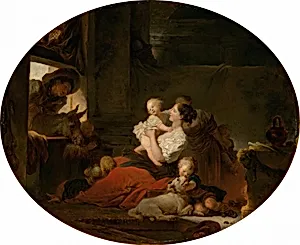
The Happy Family
c. 1775
Medium
oil on canvas
Dimensions
overall (oval): 53.9 × 65.1 cm (21 1/4 × 25 5/8 in.) framed: 73.66 × 83.82 × 10.16 cm (29 × 33 × 4 in.)
Classification
Painting
Department
CF
Museum
National Gallery of Art, Washington, D.C.
Credit
Timken Collection
Accession Number
1960.6.12
Rights
Public Domain
Art Historical Context
Jean-Honoré Fragonard’s *The Happy Family* (c. 1775) captures the playful spirit of French Rococo painting at its most intimate. Working in the final decades of the ancien régime, Fragonard specialized in light-filled scenes of domestic joy and romantic affection. The oval format, popular for over-door decorations in elegant Parisian interiors, invites viewers into a tender moment of family life rendered with the artist’s signature fluid brushwork and luminous color. Painted in oil on canvas, the work demonstrates Fragonard’s technical brilliance: rapid, confident strokes create a sense of movement and warmth while maintaining an overall harmony of soft pastels and golden tones. Such modestly scaled oval canvases were prized by collectors for their ability to bring graceful charm to private rooms rather than grand public spaces. Today in the National Gallery of Art’s Timken Collection, the painting offers a delightful glimpse into eighteenth-century ideals of happiness and leisure, reminding visitors of the Rococo era’s emphasis on pleasure, sentiment, and refined domesticity.
About the Artist
Jean Honoré Fragonard · 1732–1806
Jean-Honoré Fragonard (1732-1806) was a French painter and printmaker whose late Rococo manner was distinguished by remarkable facility, exuberance, and hedonism. Born in Grasse, he moved to Paris where he trained under Jean-Baptiste Chardin and François Boucher, winning the prestigious Prix de Rome in 1752. After studying in Italy alongside Hubert Robert, Fragonard returned to Paris in 1761 to fi...