
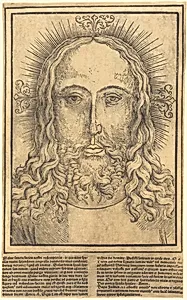
The Head of Christ
probably 1500/1510
Medium
woodcut
Classification
Department
CG-E
Museum
National Gallery of Art, Washington, D.C.
Credit
Rosenwald Collection
Accession Number
1943.3.521
Rights
Public Domain
Art Historical Context
*The Head of Christ*, a poignant woodcut from probably 1500–1510, exemplifies the anonymous mastery of a German artist from the late 15th century. during the cusp of the Northern Renaissance, this print captures the solemn visage of Christ in a style typical of devotional imagery popular in Germany at the time. Woodcuts like this one were revolutionary, as they allowed for the inexpensive reproduction and widespread dissemination of religious art, bringing spiritual icons into homes and churches across Europe. The technique of woodcut involved carving an image in reverse onto a wooden block, inking it, and pressing it onto paper— a labor-intensive process that demanded precision to achieve expressive lines and subtle shading through cross-hatching. In an era dominated by panel paintings and manuscripts, such prints democratized art, fostering personal piety amid the religious fervor preceding the Reformation. This piece reflects the era's focus on Christ's humanity, inviting quiet contemplation. Housed in the National Gallery of Art's Rosenwald Collection (Department CG-E), *The Head of Christ* stands as a testament to early printmaking's cultural impact, bridging Gothic traditions with emerging Renaissance naturalism. Visitors will appreciate its intimate scale and timeless spiritual resonance.
About the Artist
German 15th Century · 1400–1500
**German 15th Century** The designation "German 15th Century" encompasses a collective of anonymous artists active in the late medieval and early Renaissance periods in Germany, primarily known through their contributions to early printmaking and panel painting. These creators emerged during a transformative era when woodcuts and engravings began democratizing religious imagery, bridging the Goth...