
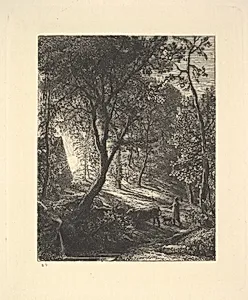
The Herdsman's Cottage, or Sunset
1880
Medium
Etching; second state of two
Dimensions
plate: 4 7/8 x 4 5/8 in. (12.4 x 11.7 cm) image: 3 7/8 x 3 in. (9.8 x 7.6 cm) sheet: 6 5/16 x 5 1/2 in. (16.1 x 13.9 cm)
Classification
Prints
Department
Drawings and Prints
Museum
Metropolitan Museum of Art, New York, NY
Credit
Bequest of Phyllis Massar, 2011
Accession Number
2012.136.594
Rights
Public Domain
Tags
Art Historical Context
Samuel Palmer’s *The Herdsman’s Cottage, or Sunset* captures a tranquil moment of rural life as evening light filters through dense woodland. Created in 1880, this small etching depicts a modest cottage nestled among towering trees, evoking the quiet harmony between humans and nature. Palmer, a leading figure of the Romantic movement and a member of the visionary “Ancients” group influenced by William Blake, devoted much of his career to celebrating the pastoral English landscape with luminous, almost spiritual intensity. The medium of etching was central to Palmer’s late work, allowing him to achieve rich tonal contrasts and delicate textures through multiple states of the plate. This second state of two refines the earlier impression, deepening shadows and heightening the glowing effect of sunset. Measuring just under five inches, the intimate scale invites close viewing, rewarding the eye with intricate details of foliage and light. Acquired by the Metropolitan Museum of Art through the bequest of Phyllis Massar, the print preserves Palmer’s lifelong fascination with the poetic beauty of the countryside. It stands as a testament to the enduring appeal of traditional landscape imagery in an era of rapid industrialization.
About the Artist
Samuel Palmer · 1805–1881
Samuel Palmer was born on 27 January 1805 in Newington, London, the son of a bookseller and sometime Baptist minister. He had little formal schooling and almost no conventional artistic training, yet he possessed an instinctive gift for drawing that led him to exhibit Turner-inspired works at the Royal Academy when he was only fourteen years old. In 1824 his mentor, the painter John Linnell, intro...