
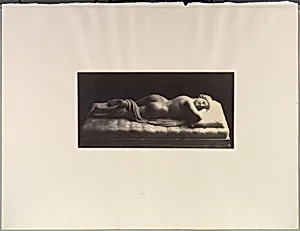
The Hermaphrodite
ca. 1861
Medium
Albumen silver print from glass negative
Dimensions
Image: 6 3/8 in. × 13 in. (16.2 × 33 cm) Mount: 18 5/8 × 24 5/8 in. (47.3 × 62.5 cm)
Classification
Photographs
Department
Photographs
Museum
Metropolitan Museum of Art, New York, NY
Credit
Gilman Collection, Purchase, The Horace W. Goldsmith Foundation Gift, through Joyce and Robert Menschel, 2005
Accession Number
2005.100.1098
Rights
Public Domain
Tags
Art Historical Context
In the mid-19th century, photographer Robert Macpherson the timeless allure of classical antiquity through his lens in Rome. *The Hermaphrodite*ca. 1861) is an exquisite albumen silver print from glass negative, measuring 6 3/8 × 13 inches. This medium, popular from the 1850s, used egg-white-coated paper to yield rich tonal gradations and remarkable detail, making it ideal for reproducing the intricate textures of sculpture. The image likely depicts an ancient statue of a hermaphrodite—a mythological figure embodying the fusion of male and female forms, rooted in Greek tales of Hermaphroditus. Macpherson's work exemplifies early photographic documentation of classical art, preserving and disseminating these treasures to a global audience when travel to sites like Rome was arduous. Produced during a boom in calotypes and wet-collodion processes, it highlights photography's emerging role as both art and scholarly tool. Today, housed in The Metropolitan Museum of Art's Gilman Collection, this print invites reflection on beauty, identity, and androgyny—themes resonant in Victorian fascination with the classical past. A window into 19th-century visual culture, it showcases how light and chemistry immortalized marble grace.
About the Artist
Robert Macpherson · 1811–1872
Robert Macpherson (1811–1872) was a Scottish artist who began his career in medicine before pivoting to painting and ultimately pioneering photography in Rome. Born in the Tayside region near Edinburgh, he enrolled at the University of Edinburgh in 1831 to study medicine but left without graduating after four years. He then trained at the Royal Scottish Academy, where he exhibited portraits from 1...