
The Herring Net
1885
Medium
Oil on canvas
Dimensions
76.5 × 122.9 cm (30 1/8 × 48 3/8 in.)
Classification
painting
Department
Arts of the Americas
Museum
Art Institute of Chicago
Accession Number
25865
Rights
Public Domain
About this artwork
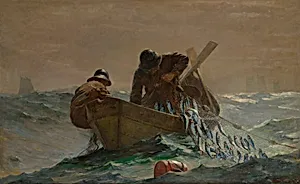
Long inspired by the sea, Winslow Homer spent time in 1881 in a fishing community in Tynemouth, England. The experience fundamentally changed his life and work. His paintings thereafter focused almost exclusively on humankind’s age-old contest with nature. In The Herring Net, executed in Prouts Neck, Maine, Homer depicted the heroic efforts of fishermen at their daily work. In a small dory, one figure hauls in glistening herring, while the other, possibly a boy, unloads the catch. Laboring far f...
Art Historical Context
Winslow Homer's *The Herring Net* (1885) captures the raw drama of late 19th-century fishing off the rugged coast of Maine. This large oil on canvas (76.5 × 122.9 cm) depicts two weathered fishermen in a small dory, straining to haul a bulging net teeming with herring from the churning Atlantic. Homer, a leading figure in American Realism, drew from his own observations during summers at Prouts Neck, immersing himself in the perilous world of commercial fishing. Painted at the height of Homer's mature style, the work showcases his masterful handling of light and water—sparkling highlights on the waves contrast with the men's somber expressions and glistening fish, evoking both the bounty and brutality of the sea. As part of a series including *The Fog Warning* and *The Life Line*, it underscores the isolation and heroism of working-class Americans, reflecting broader themes of industrialization's impact on traditional livelihoods. Housed in the Art Institute of Chicago's Arts of the Americas collection, *The Herring Net* remains a powerful testament to Homer's legacy, blending documentary precision with emotional depth to draw viewers into the timeless struggle between man and nature.
About the Artist
Winslow Homer · 1836–1910
Winslow Homer (1836-1910) was one of America's greatest painters and a preeminent figure in 19th-century American art. Largely self-taught, Homer began his career as a commercial illustrator and Civil War correspondent for Harper's Weekly before becoming renowned for his powerful marine subjects and landscape paintings. His mastery of both oil and watercolor, combined with his uncompromising reali...