
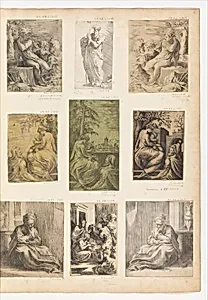
The Holy Family
ca. 1538–42 (?)
Medium
Etching
Classification
Prints
Department
Drawings and Prints
Museum
Metropolitan Museum of Art, New York, NY
Credit
Harris Brisbane Dick Fund, 1927
Accession Number
27.78.2(311)
Rights
Public Domain
Tags
Art Historical Context
Andrea Schiavone, also known as Andrea Meldolac. 1522–1563), was a Venetian painter and printmaker whose dynamic style bridged the High Renaissance and Mannerism. Active in Venice during the mid-16th century, drew inspiration from masters like Titian and Parmino. *The Holy Family*, an etching dated around 1538–42, this tender religious scene featuring the Madonna, Child, attendant saints—a motif central to Christian devotion during the Counter-Reformation era, emphasizing familial piety and divine grace. Etching, a revolutionary printmaking technique Schiavone helped pioneer in Italy, involved drawing acid-resistant lines on a metal plate for biting with acid, yielding fluid, expressive lines impossible in traditional engraving. This medium allowed artists like Schiavone to reproduce intricate compositions affordably, spreading Mannerist elegance—marked by elongated figures and dramatic poses—to a wider audience beyond elite patrons. Housed in the Metropolitan Museum of Art's Drawings and Prints department (acquired via the Harris Brisbane Dick Fund in 1927), this print exemplifies Schiavone's innovative fusion of Venetian warmth and northern precision. Visitors will appreciate its intimate scale and masterful linework, offering a window into Renaissance print culture's role in shaping faith and art across Europe.
About the Artist
Andrea Schiavone (Andrea Meldola) · 1510–1563
Andrea Schiavone, born Andrea Meldolla around 1510 or 1515 in Zara (modern Zadar, Croatia), in Venetian-ruled Dalmatia, hailed from a family rooted in Meldola near Forlì in Romagna, Emilia-Romagna. His father, Simon Meldolla, served as a garrison commander there, and both parents originated from Meldola, where the family held property into the early 16th century. Nicknamed "Schiavone"—"the Slav"—a...