
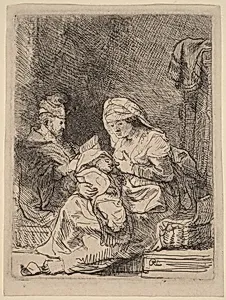
The Holy Family
c. 1632
Medium
etching
Dimensions
plate: 9.6 x 7.3 cm (3 3/4 x 2 7/8 in.) sheet: 10.3 x 7.9 cm (4 1/16 x 3 1/8 in.)
Classification
Department
CG-E
Museum
National Gallery of Art, Washington, D.C.
Credit
Print Purchase Fund (Rosenwald Collection)
Accession Number
1975.5.1
Rights
Public Domain
Art Historical Context
In the intimate glow of Rembrandt van Rijn's *The Holy Family* (c. 1632), we encounter a tender depiction of Mary, Joseph, and the child, crafted as a small etching measuring just 9.6 x 7.3 cm on the plate. This Dutch Golden Age masterpiece, housed in the National Gallery of's Rosenwald Collection, exemplifies Rembrandt's early mastery of printmaking during his Amsterdam years, when he was rising to fame for his innovative religious subjects. Rembrandt, a Baroque genius, revolutionized etching—a technique using acid to incise intricate lines into a copper plate—infusing his prints with dramatic chiaroscuro (light and shadow) and profound emotional depth. Unlike larger paintings, this diminutive work invited personal devotion, allowing multiple impressions for widespread distribution among 17th-century collectors and the faithful. Its compact scale belies the artist's virtuosic control, with fine lines evoking warmth and quiet spirituality. As a window into Rembrandt's prolific etching output—over 300 in his lifetime—this piece highlights the era's blend of Protestant piety and artistic innovation, bridging intimate faith with public artistry. A gem for print enthusiasts, it reminds us how small works can capture eternal humanity.
About the Artist
Rembrandt van Rijn · 1606–1669
Rembrandt Harmenszoon van Rijn (1606–1669) stands as one of the greatest visual artists in the history of Western art and the most important Dutch painter of the 17th century. Born in Leiden to a prosperous miller's family, Rembrandt transformed painting through his revolutionary use of light and shadow, his psychological depth in portraiture, and his elevation of etching to a fine art. His approx...