
The Holy Family on their flight into Egypt
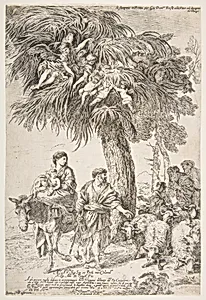
Medium
Etching
Dimensions
sheet: 11 7/16 x 7 3/4 in. (29 x 19.7 cm)
Classification
Prints
Department
Drawings and Prints
Museum
Metropolitan Museum of Art, New York, NY
Credit
Purchase, Joseph Pulitzer Bequest, 1917
Accession Number
17.50.17-40
Rights
Public Domain
Tags
Art Historical Context
In Giovanni Benedetto Castiglione’s etching “The Holy Family on their flight into Egypt,” created around 1647, the artist portrays the biblical journey of Mary, Joseph, and the infant Jesus as they seek safety in Egypt. The scene includes protective angels alongside humble donkeys and sheep, blending the sacred with the everyday world of travel and nature. This modest-sized print, roughly 11 by 8 inches, captures a moment of quiet urgency through careful line work typical of the medium. Castiglione, known as Il Grechetto, was an Italian Baroque artist celebrated for his expressive etchings that often featured animals and religious subjects. Etching allowed him to achieve rich textures and dynamic movement, helping devotional images circulate more widely during the 17th century. The work reflects the period’s fascination with storytelling that feels both dramatic and approachable. Acquired by the Metropolitan Museum of Art in 1917 through the Joseph Pulitzer Bequest, the print continues to invite reflection on themes of faith and refuge. Its lively yet intimate composition highlights Castiglione’s skill at making timeless stories feel vividly present.
About the Artist
Giovanni Benedetto Castiglione (Il Grechetto)|Giovanni Domenico de Rossi · 1609–1664
Giovanni Benedetto Castiglione, known as Il Grechetto, was baptized on March 23, 1609, in Genoa and died on May 5, 1664, in Mantua. Born into a large family, he collaborated closely with his brother Salvatore, an artist who shared his talents, and later taught his son Francesco, whose works were sometimes confused with his own. His parents placed him in the studio of Giovanni Battista Paggi, where...