
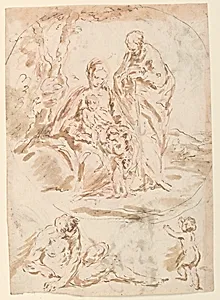
The Holy Family
Classification
figures
Department
Smithsonian Collection
Museum
Smithsonian American Art Museum
Credit
Gift of Hugh Cassel
Accession Number
1958-143-12
Rights
Public Domain
About this artwork
Research in Progress
Art Historical Context
Giovanni Benedetto Castiglione, an innovative Italian artist from Genoa (1609–1664), *The Holy Family* during early career in the 1620s. Born into a noble family, Castiglione—nicknamed "Il Grechetto"— under local masters and drew inspiration from Flemish Baroque painters like Rubens and Van Dy. This period marked the height of the Baroque era in Italy, where religious themes flourished amid the Catholic Counter-Reformation, emphasizing emotional depth and dramatic light to inspire devotion. *The Holy Family* likely portrays the tender scene of Mary, the Christ Child, and Saint Joseph, a beloved motif symbolizing domestic piety and divine humanity. Castiglione's style is characterized by fluid, expressive figures with loose brushwork and a masterful play of light and shadow, techniques he later perfected in his pioneering monotypes and etchings. Though the medium remains unidentified, its classification as "figures" highlights the artist's skill in capturing intimate human gestures amid spiritual grandeur. Now part of the Smithsonian American Art Museum's collection through the generous gift of Hugh Cassel, this work exemplifies Castiglione's blend of Genoese elegance and northern influences. Ongoing research promises to reveal more about its techniques and provenance, inviting visitors to ponder its role in bridging Italian Baroque traditions with global collections.