
The Holy Trinity
c. 1550 - c. 1574
Medium
reverse painting on glass
Dimensions
56.5; 43.5; 40.2; 5.5; 26.5
Rights
Public Domain
About this artwork
…; donated by Antonie Friederike Maria Bodenheim, née Rehrman (1889-?) Amsterdam, to the Koninklijk Oudheidkundig Genootschap, 1947;{Van Thiel 1995, p. 64.} on loan from the Koninklijk Oudheidkundig Genootschap to the museum, since 1973
Art Historical Context
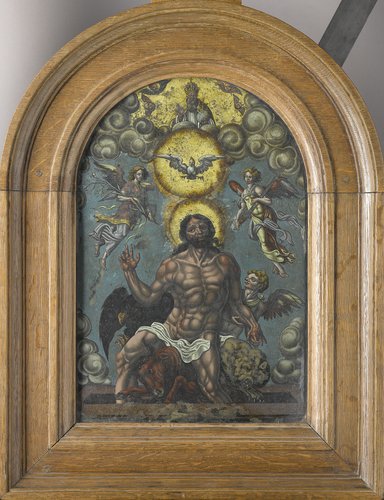
Maarten van Heemskerck’s *The Holy Trinity* offers a luminous interpretation of one of Christianity’s most profound mysteries. Created in the Netherlands between roughly 1550 and 1574, the small panel reflects the religious devotion of the late Renaissance while showcasing van Heemskerck’s distinctive mannerist style, shaped by his travels to Italy and his study of classical forms. The work is painted on the reverse side of glass, a technically demanding medium prized during the sixteenth century. By applying pigments behind the transparent surface, the artist achieved a jewel-like brilliance and protected the delicate image from wear, making such pieces especially suitable for private prayer or small altars. Measuring just over 40 by 26 centimeters, this intimate devotional object invites close contemplation. Now in the Rijksmuseum, it stands as a fine example of how Northern European artists combined spiritual subject matter with innovative techniques to heighten the viewer’s sense of the sacred.