
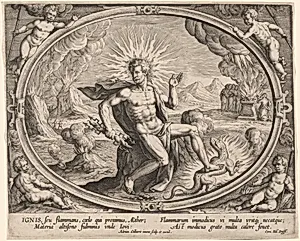
Ignis (Fire)
after 1587
Medium
engraving on laid paper
Dimensions
plate (approx): 17.2 × 21.2 cm (6 3/4 × 8 3/8 in.) sheet (approx): 17.6 × 21.5 cm (6 15/16 × 8 7/16 in.)
Classification
Department
CG-E
Museum
National Gallery of Art, Washington, D.C.
Credit
Ruth and Jacob Kainen Memorial Acquisition Fund
Accession Number
2017.38.3
Rights
Public Domain
Art Historical Context
**Ignis (Fire)** by Adriaen Colla, created after 1587,ly embodies the destructive yet vital force of fire through intricate engraving on laid paper. This Flemish artist's precise technique—using a burin to carve fine lines into a copper plate—allowed for rich tonal contrasts and detailed imagery, making it a prime example of late Renaissance printmaking. Measuring about 17 x 21 cm, the plate's modest scale belies its technical sophistication, typical of Collaert's output from Antwerp's vibrant workshop scene. As part of a probable series on the Four Elements, *Ignis* reflects the era's fascination with classical allegory and natural philosophy, drawing from humanist ideas popularized in Northern Europe during the Dutch Revolt. Collaert, a master engraver trained in the Van Haarlem circle, excelled in reproductive prints that disseminated elaborate designs to a wide audience beyond the elite. Engravings like this were affordable, portable art forms, fueling cultural exchange across Europe. Acquired through the Ruth and Jacob Kainen Memorial Acquisition Fund at the National Gallery of Art, this work highlights printmaking's role in preserving symbolic motifs. Visitors, imagine fire's dance etched in metal— a timeless nod to humanity's awe of nature's power.