
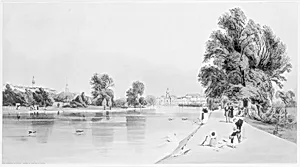
The Horse Guards &c. from St. James's Park
Medium
Lithograph, hand-colored
Dimensions
Sheet: 9 7/16 × 17 5/8 in. (24 × 44.7 cm)
Classification
Prints
Department
Drawings and Prints
Museum
Metropolitan Museum of Art, New York, NY
Credit
Rogers Fund, 1919
Accession Number
19.71.2(14)
Rights
Public Domain
Tags
Art Historical Context
In the heart of London's St. James's Park, Thomas Shotter Boys captures a bustling Victorian tableau in *The Horse Guards &c. from St. James's Park* (1842). This hand-colored lithograph vividly portrays the park's serene pond and tree-lined paths framing the distant grandeur of the Horse Guards Parade, a ceremonial site near Buckingham Palace where the Household Cavalry performed daily duties. Boys, a masterful British lithographer influenced by his Parisian training, teams up with printer Charles Joseph Hullmandel to evoke the lively urban energy of early 19th-century England. Lithography, perfected by innovators like Hullmandel, allowed Boys to achieve watercolor-like subtlety in tone and color through meticulous hand-coloring on a 9 7/16 × 17 5/8 in. sheet. This technique made detailed topographical views affordable and popular, democratizing art for a growing middle class eager for nostalgic glimpses of the capital's evolving landscape amid rapid industrialization. Acquired through the Rogers Fund in 1919, this print from the Metropolitan Museum of Art's Drawings and Prints department exemplifies Boys' signature style—precise yet atmospheric—offering visitors a window into Regency-era pomp and the timeless allure of London's royal parks.
About the Artist
Thomas Shotter Boys|Thomas Boys|Charles Joseph Hullmandel · 1803–1874
Thomas Shotter Boys was born on 2 January 1803 in Pentonville, London, and received his first professional training as an apprentice to the engraver George Cooke. When his apprenticeship concluded he crossed the Channel to Paris, a move that would transform his artistic direction entirely. There he encountered Richard Parkes Bonington, the brilliant English watercolourist whose fresh, luminous ren...