
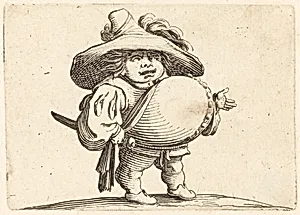
Man with Big Belly
c. 1622
Medium
etching and engraving on laid paper
Dimensions
plate: 6.4 × 8.9 cm (2 1/2 × 3 1/2 in.) sheet: 9.5 × 10.3 cm (3 3/4 × 4 1/16 in.)
Classification
Department
CG-E
Museum
National Gallery of Art, Washington, D.C.
Credit
R.L. Baumfeld Collection
Accession Number
1969.15.435
Rights
Public Domain
Art Historical Context
Jacques Callot's *Man with Big Belly*, around 1622, is a delightful yet incisive etching and engraving on laid paper, just 6.4 × 8.9 cm on the plate. This tiny print, now housed in the National Gallery Art's R.L. Baumfeld Collection, exemplifies French artist's mastery during the Baroque era. Callot, a pioneering printmaker who worked across Italy and France, was renowned for his intricate small-scale etchings that captured the vibrancy and grit of everyday life. Likely part of Callot's celebrated *Gobbi* series—featuring exaggerated, grotesque figures like hunchbacks and rotund characters—this work showcases his satirical eye for human folly. The combination of etching's fluid, spontaneous lines and engraving's crisp precision allowed Callot to render fine details, from the man's bulging form to his expressive face, in a format ideal for collectors and broad distribution. These affordable prints democratized art, blending humor with social commentary on physical and societal "deformities." Callot's technical innovations influenced generations of printmakers, making works like this not just curiosities, but cornerstones of graphic art history. Visitors, imagine holding this gem—its wit still pokes fun at vanity across centuries!
About the Artist
Jacques Callot · 1592–1635
Jacques Callot (1592–1635) was a French printmaker and draftsman from the Duchy of Lorraine, widely regarded as one of the first great artists to practice the graphic arts exclusively. His more than 1,400 etchings chronicled the breadth of 17th-century life, from Medici court festivities to the brutal realities of warfare. Callot revolutionized etching through technical innovations including the é...