
The Hydraulic Machine
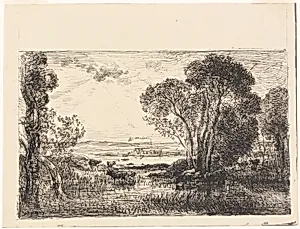
Medium
Cliché-verre on ivory photographic paper
Dimensions
21.2 × 34.5 cm (8 3/8 × 13 5/8 in.)
Classification
cliché-verre
Department
Prints and Drawings
Museum
Art Institute of Chicago
Accession Number
92341
Rights
Public Domain
Art Historical Context
**The Hydraulic Machine** (1862) by Charles-François Daubigny the artist's fascination with the French countryside through an innovative photographic process. Daubigny, a leading in the Barbizon school precursor to Impressionism—often depicted the serene landscapes along the Seine River, where he lived and worked on his houseboat studio. This work, housed in the Art Institute of Chicago's Prints Drawings department, measures 21.2 × 34.5 cm and exemplifies his shift toward experimental media in the mid-19th century. The medium, cliché-verre on ivory photographic paper, blends drawing and photography in a rare technique popular among Barbizon artists like Daubigny and Corot. By etching or painting directly on a glass plate with opaque substances to create a negative, the artist then contact-printed it onto light-sensitive paper, producing unique, painterly images with soft tonal gradients. This "photographic drawing" bridged traditional art and emerging technology, allowing Daubigny to achieve luminous effects reminiscent of his oil landscapes while exploring light and texture in new ways. Created during a period of rapid industrialization, *The Hydraulic Machine* likely portrays a water-pumping device amid rural scenery, highlighting humanity's harmonious integration with nature—a recurring Daubigny theme. Its historical significance lies in showcasing 19th-century artistic innovation, making it a gem for visitors interested in the dawn of modern photography. (198 words)
About the Artist
Charles François Daubigny (French) · 1817 –1878
French, Paris 1817–1878 Paris