
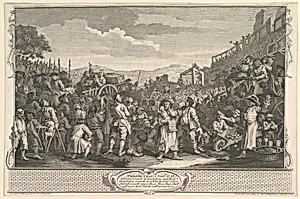
The Idle 'Prentice Executed at Tyburn (Industry and Idleness, plate 11)
September 30, 1747
Medium
Etching and engraving; third state of three
Dimensions
sheet: 10 3/8 x 15 3/4 in. (26.4 x 40 cm)
Classification
Prints
Department
Drawings and Prints
Museum
Metropolitan Museum of Art, New York, NY
Credit
Gift of Sarah Lazarus, 1891
Accession Number
91.1.19
Rights
Public Domain
Tags
Art Historical Context
William Hogarth's *The Idle 'Prenticeed at Tyburn*, 11 from his renowned 1747 series *Industry and Idleness*, delivers a stark moral warning through vivid satire. This etching and engraving captures the grim public execution of the idle apprentice Tom Idle at London's infamous Tyburn gallows, contrasting sharply with the prosperous fate of his diligent counterpart, Francis Goodchild. Hogarth, a pioneering English artist, used this 12-plate narrative sequence—like an early comic strip—to champion hard work and virtue amid 18th-century London's social upheavals, where apprenticeships shaped class mobility. The bustling scene teems with soldiers, a roaring crowd, and horses, evoking the chaotic spectacle of Tyburn hangings that drew thousands as grim entertainment. Hogarth's intricate etching and engraving technique, in this rare third state of three, allowed for detailed cross-hatching and mass production, making his moral tales accessible to the working class. Donated to the Metropolitan Museum of Art in 1891, this 10 3/8 x 15 3/4 in. print exemplifies Hogarth's satirical genius, blending realism with biting commentary on idleness, crime, and justice. (198 words)
About the Artist
William Hogarth · 1697–1764
William Hogarth (1697-1764) was an English painter, printmaker, and pictorial satirist who became the first great English-born artist to attract admiration abroad. Born into poverty in London, the son of a failed schoolmaster who was imprisoned for debt, Hogarth's early experiences with the harsh realities of 18th-century urban life profoundly shaped his artistic vision. After apprenticing with si...