
The Invasion, Plate 2: England
March 8, 1756
Medium
Etching; third state of three
Dimensions
plate: 12 9/16 x 15 1/4 in. (31.9 x 38.8 cm) sheet: 13 7/16 x 16 5/16 in. (34.2 x 41.4 cm)
Classification
Prints
Department
Drawings and Prints
Museum
Metropolitan Museum of Art, New York, NY
Credit
Gift of Sarah Lazarus, 1891
Accession Number
91.1.135
Rights
Public Domain
Tags
Art Historical Context
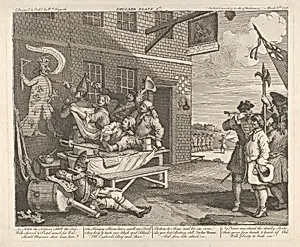
William Hogarth's *The Invasion, Plate : England* (1756) is a masterful etching from his satirical series responding to the looming threat of French invasion during the early Seven Years' War. Created amid rising Anglo-French tensions, Hogarth used his prints to rally British spirits through biting humor, poking fun at military blunders on both sides. This third-state impression captures Plate 2's chaotic English scene, alive with soldiers drilling ineptly amid civilians—men, women, and sturdy buildings—highlighting the absurdity of amateur preparations against a perceived enemy. Hogarth, a pioneer of narrative satire in British art, infused Rococo exuberance with moral commentary, blending caricature and social critique. His etching technique, with its precise, fluid lines, allowed intricate details that rewarded close viewing, making prints accessible yet profound for 18th-century audiences. This work exemplifies his "modern moral subjects," turning current events into enduring visual wit. Measuring about 12½ by 15¼ inches on the plate, it's a gem in the Metropolitan Museum of Art's Prints collection, gifted in 1891. Visitors love spotting Hogarth's sly details, like flustered recruits, reminding us how art can lampoon fear into laughter.
About the Artist
William Hogarth · 1697–1764
William Hogarth (1697-1764) was an English painter, printmaker, and pictorial satirist who became the first great English-born artist to attract admiration abroad. Born into poverty in London, the son of a failed schoolmaster who was imprisoned for debt, Hogarth's early experiences with the harsh realities of 18th-century urban life profoundly shaped his artistic vision. After apprenticing with si...