
The Isolated Fort
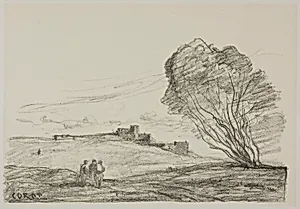
Medium
Transfer lithograph printed in black on ivory China paper laid down on white wove paper
Dimensions
Image: 18.7 × 27 cm (7 3/8 × 10 11/16 in.); Sheet: 30 × 46.5 cm (11 13/16 × 18 5/16 in.)
Classification
lithograph
Department
Prints and Drawings
Museum
Art Institute of Chicago
Accession Number
84470
Rights
Public Domain
Art Historical Context
### The Isolated Fort by Jean-Baptiste-Camille Corot into the tranquil world ofThe Isolated Fort* (1874), a captivating transfer lithograph by Jean-Baptiste-Camille Cor, one of the 19th century's most poetic landscape artists. A master of the Barbizon school and precursor to Impressionism, Corot renowned for his soft, depictions of nature, often evoking a sense of introspection. Created late in his career—just a year before his death—this print likely captures an evocative, solitary fort amid expansive scenery, embodying his lifelong fascination with atmospheric light and subtle form. Printed in black ink on delicate ivory China paper laid down on white wove paper (image: 18.7 × 27 cm), the transfer lithograph technique allowed Corot to draw fluidly on paper before transferring the image to a lithographic stone. This innovative method preserved the spontaneity of his hand while enabling multiple impressions, making his vision accessible beyond original paintings. Housed in the Art Institute of Chicago's Prints and Drawings department, it highlights lithography's rise in the 19th century as a democratic medium for artists. Corot's work bridges Romanticism and modernism, inviting viewers to ponder isolation and harmony in nature. Gaze upon it and feel the gentle hush of a forgotten outpost, a testament to his enduring legacy in printmaking.