
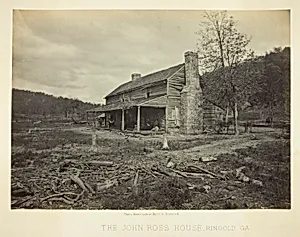
The John Ross House, Ringold, GA
Medium
Albumen print, plate 16 from the album "Photographic Views of the Sherman Campaign" (1866)
Dimensions
Image/paper: 25.6 × 35.9 cm (10 1/8 × 14 3/16 in.); Album page: 41 × 50.8 cm (16 3/16 × 20 in.)
Classification
albumen silver print
Department
Photography and Media
Museum
Art Institute of Chicago
Accession Number
32066
Rights
Public Domain
Art Historical Context
Step into the shadowed aftermath of the Civil War with George N. Barnard's *The John Ross House, Ring, GA* (1866), an albumen print from his seminal album *Photographic Views of the Sherman Campaign*. As General William T. Sherman's forces carved a path of destruction through Georgia during the 1864 Atlanta Campaign and March to the Sea, Barnard, the Union's chief photographer, captured the war's grim toll. This image, plate 16, depicts the modest home of John Ross, principal chief of the Cherokee Nation, standing amid the scarred landscape of Ringgold, Georgia—a poignant reminder of how conflict rippled through civilian and Native American lives. Crafted as an albumen silver print, the work showcases mid-19th-century photography's technical marvel: a light-sensitive emulsion made from egg whites coated on paper, yielding rich tonal depth and fine detail in Barnard's 25.6 × 35.9 cm image. Mounted on a grand 41 × 50.8 cm album page, it invited viewers to confront the war's ruins up close, blending documentary precision with subtle artistry. Barnard's straightforward composition emphasized devastation without sentimentality, influencing how Americans visualized Reconstruction. Housed in the Art Institute of Chicago's Photography and Media Department, this print endures as a cultural artifact, bridging military history, Cherokee heritage, and the birth of photojournalism. It whispers of resilience amid ruin, urging us to reflect on war's enduring scars.
About the Artist
George N. Barnard · 1819–present
George N. Barnard (1819–1902) was a pioneering American photographer whose six-decade career spanned the dawn of the medium, from daguerreotypes to Civil War documentation. Born into a farming family in Coventry, Connecticut, on December 23, 1819, he lost his father at age seven and apprenticed in family businesses before marrying in 1843 and relocating to Oswego, New York. There, he launched one ...