
The Judgment of Paris
1535–55
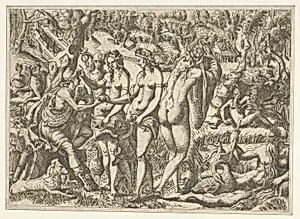
Medium
Etching
Dimensions
Mount: 10 15/16 in. × 7 9/16 in. (27.8 × 19.2 cm) Sheet (trimmed): 7 3/8 × 5 1/4 in. (18.8 × 13.3 cm)
Classification
Prints
Department
Drawings and Prints
Museum
Metropolitan Museum of Art, New York, NY
Credit
Harris Brisbane Dick Fund, 1917
Accession Number
17.3.1494
Rights
Public Domain
Tags
Art Historical Context
In the mid-16th century, artists Jean Mignon and Luca Pen, key figures in the Fontainebleau School, created *The Judgment of Paris*, an exquisite etching capturing the ancient Greek myth where Trojan prince Paris must choose the fairest goddess among Hera, Athena, and Aphrodite. This small-scale print (sheet trimmed to just 7 3/8 × 5 1/4 inches) brims with Mannerist elegance: graceful femaleudes, swirling drapery and symbolic animals like sw, evoking the divine beauty and rivalry at the heart of the tale, which sparked the Trojan War. Etching, a innovative technique popularized in the Renaissance, allowed Mignon and Penni to achieve fine, fluid lines and rich tonal contrasts directly on metal plates, making complex mythological scenes accessible to collectors beyond grand frescoes. Associated with King Francis I's opulent Fontainebleau Palace, their work blended Italian influences from Raphael and Rosso Fiorentino with French refinement, elevating printmaking as a medium for disseminating elegant nudes and allegories. Today, housed in the Metropolitan Museum of Art's Drawings and Prints department (acquired via the Harris Brisbane Dick Fund in 1917), this piece highlights the cultural vogue for classical mythology during the French Renaissance, inviting viewers to ponder timeless themes of judgment, vanity, and desire through its intricate, intimate detail.