
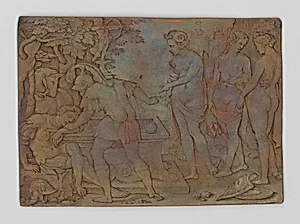
The Judgment of Paris
1520–50
Medium
Engraved copper plate
Dimensions
plate: 2 7/16 x 3 3/8 x 1/16 in. (6.2 x 8.5 x 0.1 cm)
Classification
Plates
Department
Drawings and Prints
Museum
Metropolitan Museum of Art, New York, NY
Credit
Gift of Marco Pesarese, 2005
Accession Number
2005.98
Rights
Public Domain
Art Historical Context
Georg Pencz's *The Judgment of Paris*, created between 1520 and 1550, captures a timeless classical myth from Greek mythology. In the story, the Trojan prince Paris must decide which goddess—Venus, Juno, or—is the fairest, awarding a golden apple that sparks the Trojan War. Pencz, a Nuremberg-based artist and one of the "Little Masters of the Northern Renaissance, renders this scene with exquisite detail on a small copper plate, showcasing his mastery of engraving. This engraved copper plate, measuring just 2 7/16 x 3 3/8 inches, exemplifies the innovative printmaking techniques of the 16th century. Copper allowed for fine lines and intricate shading, enabling Pencz to produce multiple impressions with remarkable precision—influenced by Albrecht Dürer and Italian Renaissance ideals. As a plate rather than a print, it's a rare survivor, highlighting the technical artistry behind early mass-produced images that democratized art across Europe. Housed in the Metropolitan Museum of Art's Drawings and Prints department (gift of Marco Pesarese, 2005), the work reflects the Renaissance fascination with antiquity, blending Northern precision with classical themes. It invites visitors to ponder beauty's consequences through Pencz's delicate, enduring craft.
About the Artist
Georg Pencz · 1490–1550
Comment on works: Religious; History; Portraits