
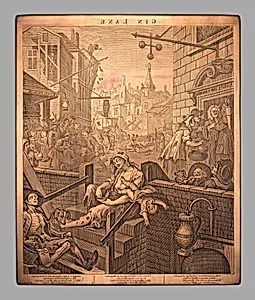
Gin Lane
1751
Medium
Engraved copper plate
Dimensions
15 7/16 x 12 7/8 in. (39.2 x 32.7 cm)
Classification
Plates
Department
Drawings and Prints
Museum
Metropolitan Museum of Art, New York, NY
Credit
Rogers Fund, 1921
Accession Number
21.55.3
Rights
Public Domain
Tags
Art Historical Context
William Hogarth's *Gin Lane* (1751) is a powerful engraved copper plate print, measuring 15 7/16 x 12 7/8 inches, that captures the artist's signature satirical style. As a leading figure in 18th-century British art, Hogarth used intricate engravings to critique vices, producing affordable prints that reached a wide audience beyond elite collectors. This work, now in the Metropolitan Museum of Art's Drawings and Prints, exemplifies his mastery of the medium, where fine lines and dense details create a chaotic urban tableau. Created amid London's "Gin Craze" of the 1740s–50s, *Gin Lane* vividly satirizes the devastating effects of cheap gin on the working class. The scene brims with men, women, and even dogs entangled in drunken despair—mad mothers neglecting children, brawls, and moral decay—serving as a stark warning against alcoholism. Paired with its optimistic counterpart *Beer Street*, it influenced the Gin Act of 1751, helping curb the epidemic through taxation and regulation. Hogarth's technique shines in the copper plate's rich tonal contrasts and symbolic details, blending caricature with social commentary. This enduring masterpiece remains a cultural touchstone, reminding us how art can drive reform and reflect humanity's struggles.
About the Artist
William Hogarth · 1697–1764
William Hogarth (1697-1764) was an English painter, printmaker, and pictorial satirist who became the first great English-born artist to attract admiration abroad. Born into poverty in London, the son of a failed schoolmaster who was imprisoned for debt, Hogarth's early experiences with the harsh realities of 18th-century urban life profoundly shaped his artistic vision. After apprenticing with si...