
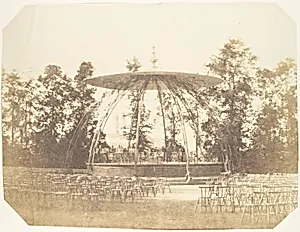
[The Kiosk, Zoological Gardens, Brussels]
Medium
Salted paper print from paper negative
Dimensions
Image: 9 1/4 × 12 1/8 in. (23.5 × 30.8 cm) Sheet: 13 3/8 × 18 1/8 in. (34 × 46 cm)
Classification
Photographs
Department
Photographs
Museum
Metropolitan Museum of Art, New York, NY
Credit
Gilman Collection, Gift of The Howard Gilman Foundation, 2005
Accession Number
2005.100.372.27
Rights
Public Domain
Tags
Art Historical Context
Step into the lush Zoological Gardens of Brussels through *The Kiosk, Zoological, Brussels* (1854–56), a captivating salted paper print by Louis-Pierre-Théophile Dubois de Nehaut This image freezes a serene moment at a fashionable 19th-century public pleasure ground, where the ornate kiosk—a picturesque pavilion—stands amid verdant gardens. Zoological gardens like this one were emerging as symbols of urban leisure and scientific curiosity, blending nature, architecture, and recreation for the growing middle class. Created via the calotype process, Dubois de Nehaut's work employs a paper negative to produce a salted paper print, a pioneering technique from the 1840s that allowed for multiple positives from one negative. This medium lent photographs a soft, painterly quality with subtle tones, bridging art and science in photography's infancy. At 9¼ × 12⅛ inches, its intimate scale invites close viewing, revealing the era's technical marvels. Part of the Metropolitan Museum of Art's Gilman Collection, this piece highlights early European photography's role in documenting everyday beauty. It captures mid-19th-century Belgium's embrace of modernity, where gardens offered escape amid industrialization—a timeless reminder of photography's power to preserve fleeting landscapes.
About the Artist
Louis-Pierre-Théophile Dubois de Nehaut · 1799–1872
Louis-Pierre-Théophile Dubois de Nehaut (1799–1872) was a French artist and early enthusiast of photography whose career bridged the worlds of traditional draughtsmanship and the new mechanical image-making technologies that transformed visual culture in the nineteenth century. Trained in the conventions of French academic art, he possessed the skills of a practiced draughtsman before turning his ...