
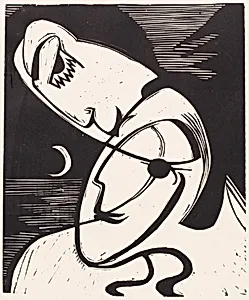
The Kiss
Medium
woodcut on wove paper
Dimensions
plate: 40.5 × 33.5 cm (15 15/16 × 13 3/16 in.) sheet: 54.7 × 42.5 cm (21 9/16 × 16 3/4 in.)
Classification
Department
CG-W
Museum
National Gallery of Art, Washington, D.C.
Credit
Gift of Ruth Cole Kainen
Accession Number
2012.92.702
Rights
Public Domain
Art Historical Context
Ernst Ludwig Kirchner's *The Kiss* (1930) captures the raw emotional intensity characteristic of German Expressionism. As a founding member of the Die Brücke group, Kirchner pioneered a style that rejected academic traditions in favor of bold colors, distorted forms, and psychological depth, often exploring themes of love, urban life, and human connection. Created late in his career while in exile in Switzerland—fleeing Nazi persecution that labeled his work "degenerate"—this print reflects his enduring fascination with intimate human bonds amid personal turmoil. Executed as a woodcut on wove paper, the work exemplifies Kirchner's mastery of the medium. Woodcuts, with their carved blocks producing stark contrasts and textured lines, suited Expressionism's emphasis on primal energy and directness. The plate measures 40.5 × 33.5 cm, with a larger sheet of 54.7 × 42.5 cm, allowing for dramatic compositions that draw viewers into the lovers' fervent embrace. Prints like this were vital for artists like Kirchner, enabling affordable reproduction and broader dissemination of avant-garde ideas. Now in the National Gallery of Art's collection (Department CG-W) through the generous gift of Ruth Cole Kainen, *The Kiss* invites visitors to ponder the timeless power of passion through Kirchner's unflinching gaze.
About the Artist
Ernst Ludwig Kirchner · 1880–1938
Ernst Ludwig Kirchner was born on May 6, 1880, in Aschaffenburg, Germany, to parents Ernst and Maria Kirchner, part of a family of Prussian descent that frequently relocated due to his father's career as a chemical technician. After early schooling in various towns, he studied architecture at the Königliche Technische Hochschule (Technical University) in Dresden from 1901 to 1905, taking courses i...