
The Lace-Maker
1876
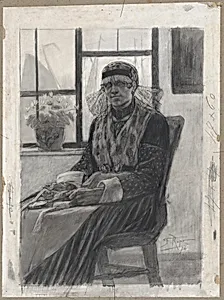
Medium
Graphite, gum arabic, locally scratched
Dimensions
Sheet: 15 3/4 × 11 5/8 in. (40 × 29.5 cm)
Classification
Drawings
Department
Drawings and Prints
Museum
Metropolitan Museum of Art, New York, NY
Credit
Van Day Truex Fund, 2016
Accession Number
2016.693
Rights
Public Domain
Tags
Art Historical Context
Félicien Rops' *The Lace-Maker*1876) is a captivating drawing that exemplifies the Belgian artist's mastery of intimate, evocative imagery during the late 19th century. Created with graphite, gum arabic, a technique of locally scratched surfaces on a sheet measuring 15 3/4 × 11 5/8 inches, this work belongs to the Metropolitan Museum of Art's Drawings and Prints collection, acquired through the Van Day Truex Fund in 2016. Rops, a key figure in Symbolism and the fin-de-siècle Decadent movement, often portrayed women with a blend of sensuality and psychological depth, moving beyond academic traditions. The medium's innovative use highlights Rops' technical prowess: graphite provides fine lines and shading, gum arabic adds subtle washes for luminosity, and strategic scratching creates textured highlights, evoking the delicate intricacy of lace itself. This scratched technique, akin to scraperboard methods, enhances the tactile quality, drawing viewers into the labor-intensive world of needlework—a traditional domain of women that Rops subtly elevates to an almost ritualistic art form. Historically, the piece reflects 1870s Europe, where industrialization clashed with artisanal crafts, symbolizing both domestic virtue and emerging feminist undercurrents. Its focus on a lace-maker invites reflection on gender roles, making it a poignant study in everyday elegance amid cultural shifts. A true gem for drawing enthusiasts!
About the Artist
Félicien Rops · 1833–1898
Félicien Rops, born Félicien Victor Joseph Rops on July 7, 1833, in Namur, Belgium, to a prosperous textile manufacturing family, displayed prodigious artistic talent from youth. The only child of Nicholas Rops and Sophie Maubile, he received private tutoring until age ten, followed by education at a Jesuit school in Namur (1843–1848), the Athénée Royal de Namur, and the Academy of Fine Arts there...