
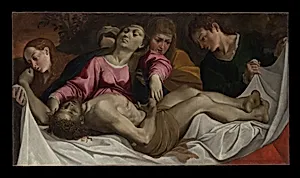
The Lamentation
ca. 1582
Medium
Oil on canvas
Dimensions
37 1/2 x 68 in. (95.3 x 172.7 cm)
Classification
Paintings
Department
European Paintings
Museum
Metropolitan Museum of Art, New York, NY
Credit
Purchase, Lila Acheson Wallace and The Annenberg Foundation Gifts; Harris Brisbane Dick, Rogers, and Gwynne Andrews Funds; Pat and John Rosenwald, Mark Fisch and Rachel Davidson, and Jon and Barbara Landau Gifts; Gift of Mortimer D. Sackler, Theresa Sackler and Family; and Victor Wilbour Memorial, Marquand, The Alfred N. Punnett Endowment, and Charles B. Curtis Funds, 2000
Accession Number
2000.68
Rights
Public Domain
Tags
Art Historical Context
**The Lamentation**, painted by Ludovico Carr around 1582, captures one of the most poignant moments Christian iconography: the of Christ's body after the Crucifixion. The large oil-on-canvas work (37½ × 68 inches) centers the Virgin Mary, Mary Magdalene, and Saint John the Evangel in a tableau of profound grief, their gestures and expressions evoking raw human emotion. As an early masterpiece by the Bolognese artist, it reflects the Carracci family's innovative approach, blending Renaissance clarity with emerging Baroque naturalism to make sacred scenes intimately relatable. Ludovico Carracci (1555–1619), alongside brothers Agostino and Annibale, spearheaded a artistic reform in late 16th-century Bologna during the Counter-Reformation era. This period demanded art that stirred devotion through realism and pathos, moving away from Mannerist stylization. Carracci's oil technique shines here, with its rich glazes and subtle modeling of flesh and drapery, creating a luminous, almost sculptural depth that draws viewers into the sorrow. Now at the Metropolitan Museum of Art, acquired in 2000 through generous gifts, *The Lamentation* exemplifies the emotional power of European religious painting. Its expansive horizontal format invites contemplation, reminding us how art bridges the divine and the deeply personal.