
Pietà
1520s
Medium
oil on panel
Dimensions
overall: 175.8 × 98.5 cm, 116 kg (69 3/16 × 38 3/4 in., 255.734 lb.) framed: 206.06 × 129.06 × 7.62 cm (81 1/8 × 50 13/16 × 3 in.)
Classification
Painting
Department
CIS-R
Museum
National Gallery of Art, Washington, D.C.
Credit
Samuel H. Kress Collection
Accession Number
1952.2.10
Rights
Public Domain
Art Historical Context
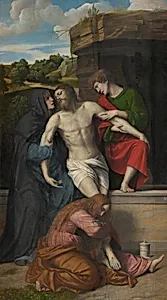
Created in the 1520s by the Brescian painter Moretto da Brescia (Alessandro Bonvicino), this monumental *Pietà* captures one of the most poignant moments in Christian iconography: the Virgin Mary cradling the lifeless body of Christ. Standing nearly six feet tall, the oil-on-panel composition was designed as an altarpiece, its imposing scale inviting worshippers to contemplate Christ’s sacrifice with quiet reverence. Moretto worked during the transition from High Renaissance ideals to early Mannerism in northern Italy. Trained in the luminous color traditions of Venice and the solid forms of Lombardy, he excelled at rendering lifelike flesh tones and rich fabrics with oil paint’s subtle glazes. Here, the cool pallor of Christ’s body contrasts with the deep folds of Mary’s robes, heightening the emotional weight of the scene while demonstrating the artist’s mastery of light and texture. Acquired through the Samuel H. Kress Collection, the painting now resides in the National Gallery of Art, where its solemn beauty continues to move visitors across centuries.
About the Artist
Moretto da Brescia · 1498–1554
**Moretto da Brescia (Alessandro Bonvicino, c. 1498–1554)** was a leading Italian Renaissance painter based in Brescia, where he produced most of his work. Born in nearby Rovato, he trained initially under the local master Fioravante (or Floriano) Ferramola and absorbed influences from earlier Brescian artists such as Vincenzo Foppa. His style also reflects strong Venetian elements, particularly f...