
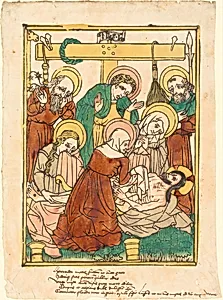
The Lamentation
c. 1450
Medium
woodcut, hand-colored in brown lake, gray, rose, yellow, green, and olive
Classification
Department
CG-E
Museum
National Gallery of Art, Washington, D.C.
Credit
Rosenwald Collection
Accession Number
1943.3.493
Rights
Public Domain
Art Historical Context
In the hushed reverence of 15th-century German art, *The Lamentation* captures a pivotal moment from the Passion of Christ: the sorrowful mourning of Jesus's body by Mary, John, and other figures after the Crucifixion. Created around 1450 by an anonymous German artist, this woodcut exemplifies the imagery that permeated Northern European religious life during the late Gothic period, bridging medieval piety and the dawn of the Renaissance. The medium—a hand-colored woodcut—is a marvel of early printmaking innovation. Woodcuts allowed for the mass production of images, democratizing sacred art for pilgrims, churches, and homes. Here, delicate hand-coloring in brown lake, gray, rose, yellow, green, and olive brings emotional depth: subtle hues evoke the pallor of death and the grief-stricken sky, heightening the viewer's empathy. This technique, common before color printing evolved, underscores the artisan's skill in transforming stark black lines into a vibrant tableau. Housed in the National Gallery of Art's Rosenwald Collection (Department CG-E), this print reflects the cultural fervor for Passion scenes, which inspired prayer and reflection amid the era's religious upheavals. A testament to woodcut's enduring legacy, it invites us to ponder humanity's shared sorrow across centuries.
About the Artist
German 15th Century · 1400–1500
**German 15th Century** The designation "German 15th Century" encompasses a collective of anonymous artists active in the late medieval and early Renaissance periods in Germany, primarily known through their contributions to early printmaking and panel painting. These creators emerged during a transformative era when woodcuts and engravings began democratizing religious imagery, bridging the Goth...