
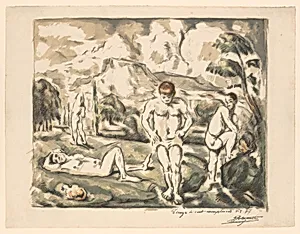
The Large Bathers (Les Baigneurs)
ca. 1898
Medium
Color lithograph on wove paper; first state of two
Dimensions
sheet: 19 1/8 x 24 15/16 in. (48.6 x 63.3 cm)
Classification
Prints
Department
Drawings and Prints
Museum
Metropolitan Museum of Art, New York, NY
Credit
Rogers Fund, 1922
Accession Number
22.94
Rights
Public Domain
Tags
Art Historical Context
**The Large Bathers (Les Baigne)**, created by Paul Cézanne 1898, is a captivating color lithograph on w paper—the first state of two impressions. Measuring nearly 20 by 25 inches, this print from the Metropolitan Museum of's Drawings and Prints collection captures Cézanne's lifelong fascination with the human figure in nature. As a pioneer of Post-Impressionism,ézanne moved beyond Impressionism's fleeting light effects, emphasizing solid, geometric forms and a structured composition that bridged 19th-century tradition with modern abstraction. The scene depicts male nudes bathing amid a lush landscape of trees, mountains, and serene waters, echoing Cézanne's iconic series of bather paintings. Rendered in vibrant lithographic colors, the work showcases his innovative technique: layering flat planes of color to build volume and depth, prefiguring Cubism's revolutionary geometry. Lithography allowed Cézanne, primarily a painter, to experiment with printmaking, making his vision accessible beyond oil canvases. This rare first-state proof, acquired via the Rogers Fund in 1922, highlights the print's technical purity before later alterations. For visitors, it offers a window into Cézanne's quest to "treat nature by means of the cylinder, the sphere, the cone," profoundly influencing Picasso and the avant-garde while celebrating the timeless harmony of body and environment.
About the Artist
Paul Cézanne · 1839–1906
Paul Cézanne (1839-1906) stands as one of the most influential figures in the history of modern art, often called the "Father of Modern Art" for his revolutionary approach to form, color, and pictorial space. Born in Aix-en-Provence to a wealthy banker who discouraged artistic pursuits, Cézanne rejected a legal career to pursue painting, though he remained financially dependent on his family until...