
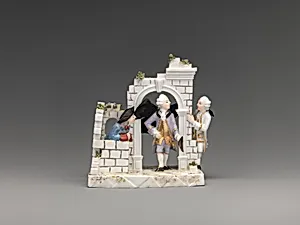
The Large Bow
Medium
Hard-paste porcelain
Dimensions
Overall (confirmed): 4 1/2 × 3 7/8 × 2 13/16 in. (11.4 × 9.8 × 7.1 cm)
Classification
Ceramics-Porcelain
Culture
German, Ludwigsburg
Department
European Sculpture and Decorative Arts
Museum
Metropolitan Museum of Art, New York, NY
Credit
Gift of Irwin Untermyer, 1964
Accession Number
64.101.327
Rights
Public Domain
Tags
Art Historical Context
Created around 1770 at the Ludwigsburg Porcelain Manufactory in Germany, *The Large Bow* exemplifies the refined decorative arts of the late Rococo period. Modeler Gottlieb Friedrich Riedel, a leading figure at the factory, helped shape its distinctive style of lively, small-scale porcelain figures. Crafted in hard-paste porcelain—the durable European equivalent of Chinese porcelain—this piece allowed for crisp modeling and delicate painted details that captured the era’s taste for elegant, theatrical subjects. Measuring just over four inches tall, the work was likely intended as a cabinet or tabletop ornament, part of the growing fashion among European elites for porcelain ensembles depicting everyday or allegorical scenes. Such figures reflected the courtly culture of Württemberg and the broader Enlightenment interest in refined domestic display. Today in the Metropolitan Museum’s collection, it offers visitors a charming glimpse into 18th-century German porcelain artistry and the technical mastery achieved by one of Europe’s celebrated manufactories.