
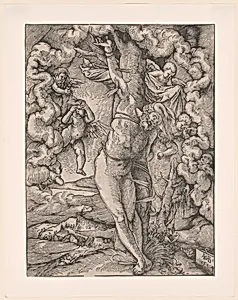
The Large Saint Sebastian
Medium
Woodcut in black on cream laid paper
Dimensions
Sheet: 31.2 × 23.4 cm (12 5/16 × 9 1/4 in.)
Classification
prints and drawing
Department
Prints and Drawings
Museum
Art Institute of Chicago
Accession Number
261904
Rights
Public Domain
Art Historical Context
Hans Baldung Grien'sThe Large Saint Sebastian*1514) is a striking woodcut print on cream laid paper, measuring 31.2 × 23.4 cm, housed in the Art Institute of's Prints and Drawings department Created during the Northern Renaissance, this monumental work showcases Baldung, a German artist and former pupil of Albrecht Dürer, at the height of his mastery in printmaking. Known for his bold, expressive style blending Gothic intensity with emerging Renaissance naturalism, Baldung infused his images with dramatic tension, erotic undertones, and a fascination with mortality—themes that set him apart from his contemporaries. The woodcut medium, a relief printing technique where the artist carves away negative space from a woodblock, allowed for rich, velvety blacks and crisp lines that were ideal for disseminating art to a wider audience in early 16th-century Europe. Saint Sebastian, the martyr pierced by arrows yet gazing heavenward, is depicted here in a powerfully muscular, almost sensual form bound to a tree stump, emphasizing human vulnerability and spiritual endurance. This "large" version, rarer and more detailed than smaller iterations, highlights Baldung's innovative use of light and shadow to create depth and pathos. As a cultural icon, Sebastian's imagery resonated in plague-ridden Europe as a protector against disease. Baldung's print not only exemplifies technical virtuosity but also captures the era's blend of piety and humanism, inviting viewers to ponder life's fragility amid beauty.
About the Artist
Hans Baldung Grien
Hans Baldung, known by the nickname Grien, was born around 1484 or 1485 in Schwäbisch Gmünd, in the Swabia region of what is now Germany. He came from a distinguished academic family — his father Johann Baldung was a university-educated jurist who served as legal adviser to the bishop of Strasbourg — making Hans a notable exception as the first male in his family not to attend university, and one ...