
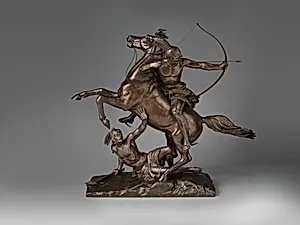
The Last Arrow
1879–80, cast 1880
Medium
Bronze
Dimensions
44 x 34 1/2 x 16 in. (111.8 x 87.6 x 40.6 cm)
Classification
Sculpture
Culture
American
Department
The American Wing
Museum
Metropolitan Museum of Art, New York, NY
Credit
Bequest of Henry H. Cook, 1905
Accession Number
05.13.1
Rights
Public Domain
Tags
Art Historical Context
### The Last Arrow Step into the tense drama of *The Last Arrow*, a bronze sculpture by Randolph Rogers between 1879 and 1880, with the final cast completed that year. Measuring 44 x 34½ x 16 inches, this work captures a pivotal moment—likely a lone archer drawing his final bow amid equestrian intensity, as suggested by its evocative title and tags evoking bows, arrows, men, horses. Rogers, a leading American sculptor based in Rome, was renowned for his neoclassical precision and ability to infuse classical techniques with romantic narratives of heroism and resolve. Bronze, Rogers' favored medium, lent enduring strength and a rich patina to his pieces, allowing intricate details like taut muscles, flowing manes, and feathered arrows to shine through lost-wax casting methods popular in the era. This technique, honed in Italian foundries, elevated American sculpture to rival European traditions during the Gilded Age. Housed in The Metropolitan Museum of Art's American Wing since Henry H. Cook's 1905 bequest, *The Last Arrow* reflects late 19th-century fascination with frontier valor and stoic endurance. Rogers' work bridges neoclassicism and emerging realism, offering visitors a poignant glimpse into America's mythic self-image.
About the Artist
Randolph Rogers · 1825–1892
Randolph Rogers (1825–1892) was a prominent American Neoclassical sculptor whose career bridged the worlds of popular genre sculpture and grand public commissions. Born on July 6, 1825, in Waterloo, New York, the son of a carpenter and millwright, Rogers grew up in Ann Arbor, Michigan, after his family relocated westward in pursuit of opportunity. Showing early aptitude for drawing and wood engrav...