
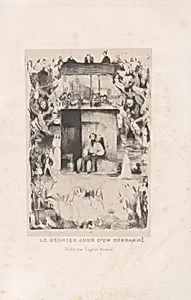
The Last Day of a Condemned Man
Medium
Etching
Dimensions
Plate: 10 3/8 × 6 5/16 in. (26.4 × 16.1 cm) Sheet: 10 5/8 × 6 11/16 in. (27 × 17 cm)
Classification
Prints
Department
Drawings and Prints
Museum
Metropolitan Museum of Art, New York, NY
Credit
Harris Brisbane Dick Fund, 1929
Accession Number
29.18.4(2)
Rights
Public Domain
Art Historical Context
This etching, created in 1833 by Célestin Nanteuil and published by Eugène Renduel, captures the haunting final moments of a prisoner awaiting execution. The work draws directly from Victor Hugo’s 1829 novel *The Last Day of a Condemned Man*, a powerful critique of capital punishment that resonated throughout Romantic-era France. Nanteuil, a leading figure in the Romantic movement, specialized in literary illustrations that conveyed intense emotion and dramatic tension. As an etching, the medium allowed for fine, expressive lines that heighten the scene’s psychological intensity while making the image widely reproducible for book editions. Measuring just over ten inches in height, the print balances intimate scale with powerful storytelling, inviting viewers to reflect on themes of justice and humanity that were fiercely debated in 19th-century society. Today housed in the Metropolitan Museum of Art’s Department of Drawings and Prints, this work exemplifies how Romantic artists used printmaking to bring literature’s moral questions to a broad audience. Its acquisition through the Harris Brisbane Dick Fund in 1929 underscores its enduring value as both an artistic achievement and a cultural artifact.
About the Artist
Eugène Renduel|Célestin Nanteuil (French|French) · 1798 |1813 –1874 |1873
French, Lormes 1798–1874 Beuvron|French (born Italy), Rome 1813–1873 Bourron-Marlotte