
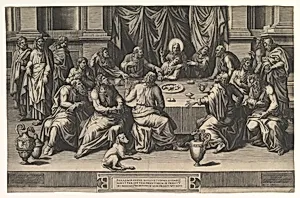
The Last Supper
Medium
Engraving; second state of four (BLL)
Dimensions
Sheet (Trimmed): 13 3/4 in. × 21 in. (34.9 × 53.3 cm)
Classification
Prints
Department
Drawings and Prints
Museum
Metropolitan Museum of Art, New York, NY
Credit
The Elisha Whittelsey Collection, The Elisha Whittelsey Fund, 1958
Accession Number
58.642.10
Rights
Public Domain
Tags
Art Historical Context
Behold *The Last Supper*, a 1551 engraving created through the collaboration of three Northern Renaissance talents: designed by Flemish painter Lambert Lombard, expertly engraved by Italian master Giorgio Ghisi, and by Antwerp printmaker Hieronymus Cock Measuring 13¾ × 21 inches (trimmed), this second state of four—from the Metropolitan Museum of Art's Elisha Whittelsey Collection—captures the biblical scene of Jesus and the Apostles in a moment of solemn communion, enriched with charming details like dogs at their feet, a nod to everyday Flemish life amid sacred narrative. Engravings like this were revolutionary in the 16th century, transforming fine art into affordable, reproducible images that spread Renaissance ideals across Europe. Ghisi's precise burin work on the copper plate yields intricate lines, dramatic chiaroscuro, and a sense of depth, making Lombard's composition accessible to collectors far beyond church walls. This print reflects the era's Mannerist tendencies—elegant figures, emotive gestures—while echoing Leonardo da Vinci's iconic fresco, yet infused with Northern realism. A treasured artifact of print history, it highlights how collaborative workshops democratized religious iconography, inviting viewers to ponder faith, fellowship, and the artistry of dissemination. Spot the saints' expressive faces and loyal hounds for a glimpse into 1550s devotion!
About the Artist
Giorgio Ghisi|Lambert Lombard|Hieronymus Cock · 1520–1582
Giorgio Ghisi (c. 1520–1582) was one of the most accomplished engravers of the Italian Renaissance, renowned for translating the monumental compositions of Raphael, Giulio Romano, and Michelangelo into the exacting medium of the burin. Born in Mantua, he trained in an environment shaped by the legacy of Giulio Romano's decoration of the Palazzo del Te, and the grandeur of that Mannerist tradition ...