
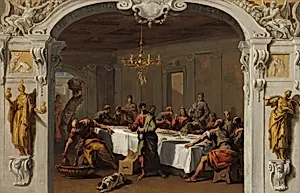
The Last Supper
1713/1714
Medium
oil on canvas
Dimensions
overall: 67 x 104 cm (26 3/8 x 40 15/16 in.) framed: 85.7 x 122.6 x 8.6 cm (33 3/4 x 48 1/4 x 3 3/8 in.)
Classification
Painting
Department
CIS-B
Museum
National Gallery of Art, Washington, D.C.
Credit
Samuel H. Kress Collection
Accession Number
1943.4.32
Rights
Public Domain
Art Historical Context
Sebastiano Ricci’s *The Last Supper* captures the solemn moment when Christ reveals his betrayal during the Passover meal. Painted in oil on canvas around 1713–1714, this modestly scaled work (roughly 26 by 41 inches) reflects the Venetian artist’s late Baroque style, which blended dramatic lighting and rich color with the emerging lightness of the Rococo period. Ricci, active across Italy and Europe, helped revive the luminous traditions of Venetian painting after a period of relative decline. The painting’s fluid brushwork and warm palette draw viewers into the intimate scene, emphasizing emotional tension among the apostles rather than grand architectural settings often seen in larger versions of the subject. Created during a time when religious commissions remained central to artistic patronage, Ricci’s interpretation balances reverence with theatrical energy, qualities that made his works popular among collectors. Today part of the National Gallery of Art’s Samuel H. Kress Collection, the canvas offers a window into early eighteenth-century Venetian art and its graceful transition from Baroque drama to Rococo elegance.
About the Artist
Sebastiano Ricci · 1659–1734
Sebastiano Ricci (1659–1734) was born in Belluno, in the Venetian Republic, and received his early training in Venice, where he was apprenticed at age twelve to the Milanese painter Federico Cervelli. Some accounts identify Sebastiano Mazzoni as his first master. A youthful scandal involving an unintended pregnancy and a charge of attempted poisoning led to imprisonment in 1678, from which he was ...